
Seeing Jesus in Every Book of the Bible: The Scarlet Thread of Redemption from Genesis to Revelation
Introduction: The Walk to Emmaus
When the risen Christ walked with two disciples on the road to Emmaus, Scripture records something profoundly important: “And beginning with Moses and all the Prophets, he explained to them what was said in all the Scriptures concerning himself” (Luke 24:27).
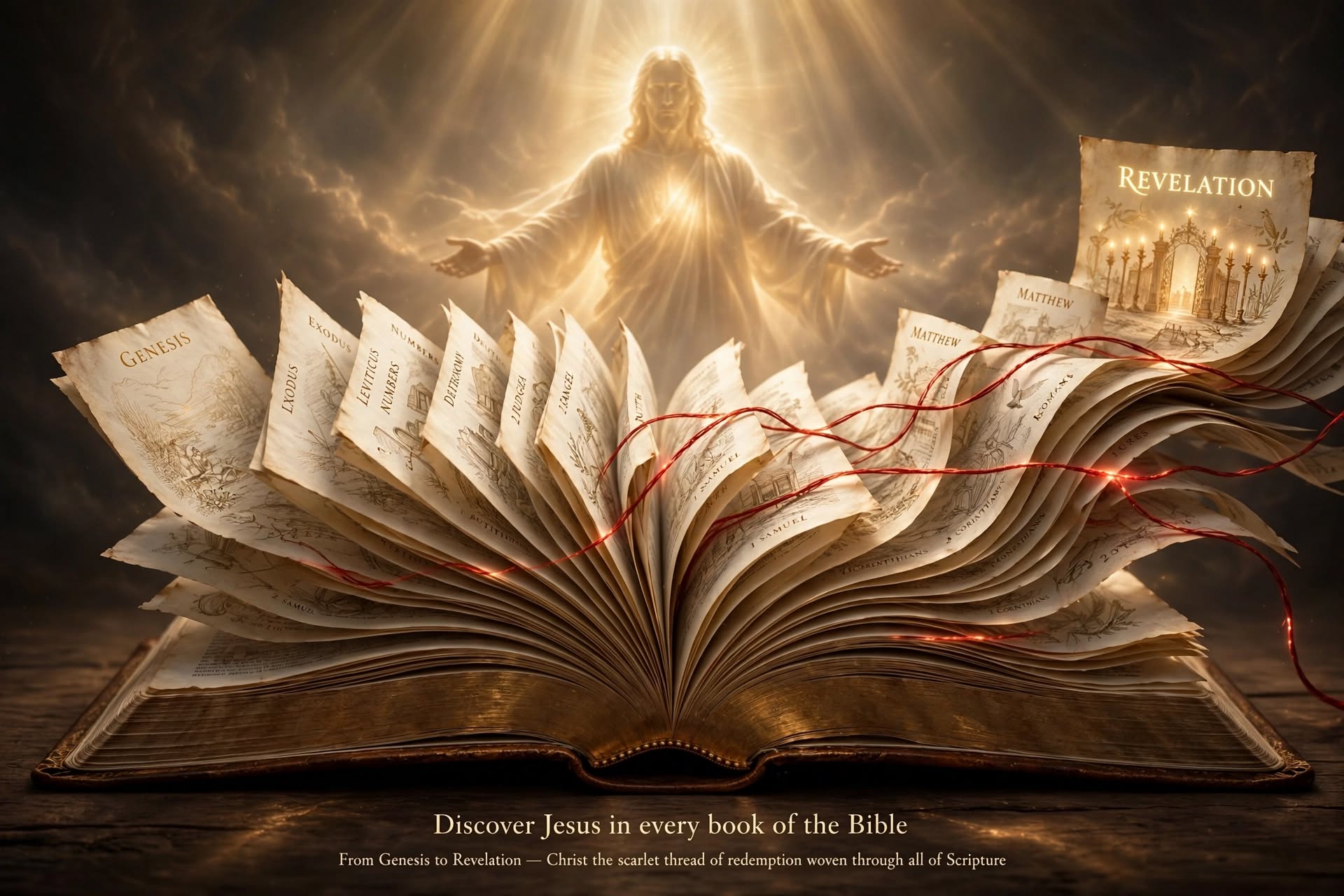
Jesus didn’t open a New Testament—it hadn’t been written yet. He opened the Hebrew Scriptures and revealed Himself on every page. As O.S. Hawkins notes in his book The Bible Code, “The Old Testament conceals Him in type and shadow; the New Testament reveals Him in full glory. Jesus is the scarlet thread of redemption woven through every book of sacred Scripture.”
This means that when we open any book of the Bible, we can encounter Jesus there. This article invites you on a journey from Genesis to Revelation, discovering how Christ appears in every single book.
The Pentateuch: Jesus in Law and Promise
Genesis: Immediately after humanity’s fall, God gave the first Messianic promise—the offspring of the woman would crush the serpent’s head (Genesis 3:15). This is the first ray of gospel light. Abraham’s offspring would bless all nations (Genesis 12:2-3), and that offspring ultimately points to Christ.
Exodus: The Passover lamb is one of the clearest types of Jesus. Just as Israel was spared death by the blood of the lamb, “Christ, our Passover lamb, has been sacrificed” (1 Corinthians 5:7). In the wilderness, the lifted bronze serpent foreshadowed the crucified Christ (John 3:14-15).
Leviticus: The entire sacrificial system points to the perfect sacrifice. Every offering—burnt, grain, peace, sin, and guilt—foreshadows Jesus offering Himself once for all, fulfilling the law’s requirements.
Numbers: Throughout the wilderness journey, Christ is the manna that sustains His people (John 6:35) and the spiritual rock that accompanies them (1 Corinthians 10:4).
Deuteronomy: Moses prophesied that God would raise up a prophet like him (Deuteronomy 18:15), and Acts applies this prophecy directly to Jesus. He is also the true “bread of life.”
Historical Books: Jesus in Kings and Deliverers
Joshua: Joshua’s very name means “Yahweh saves”—the same root as “Jesus.” He led the people into the Promised Land, foreshadowing Jesus leading us into true rest.
Judges: In the repeated cycle of rebellion and deliverance, every judge points to the ultimate Deliverer—Jesus Christ.
Ruth: Boaz, as the kinsman-redeemer, foreshadows Christ’s role as our Redeemer. He does not stand distant from our need but enters our desperation to purchase us with His own blood.
1 & 2 Samuel: David’s rise and reign point to the “Son of David”—Jesus. God promised David’s throne would endure forever (2 Samuel 7:12-16), a promise fulfilled completely in Christ.
1 & 2 Kings and 1 & 2 Chronicles: Even amid Israel’s and Judah’s decline, God preserved a remnant and maintained the Messianic line. The temple’s construction and worship point to the One who is “greater than the temple.”
Ezra and Nehemiah: The rebuilding of the temple and walls foreshadows Jesus rebuilding lives devastated by sin.
Esther: Though God’s name is never mentioned, His hidden hand saves His people. Jesus is our hidden refuge, working salvation even when He seems silent.
Wisdom and Poetry: Jesus in the Human Heart
Job: In the depths of suffering, Job declared, “I know that my redeemer lives” (Job 19:25). This Redeemer is Christ, who sympathizes with our pain because He endured the agony of the cross.
Psalms: The Psalms overflow with Christ. He is the suffering Savior (Psalm 22), the good Shepherd (Psalm 23), the glorious King entering the temple (Psalm 24), and the eternal Priest-King (Psalm 110). Jesus Himself quoted the Psalms to identify Himself.
Proverbs: Christ is the wisdom of God (1 Corinthians 1:24), in whom all treasures of wisdom and knowledge are hidden.
Ecclesiastes: In the “vanity of vanities,” true meaning and satisfaction are found only in Christ.
Song of Solomon: Christ is our Bridegroom, loving us with an everlasting love. As Hawkins observes, “In the Song of Solomon, He is our Bridegroom.”
Major Prophets: Jesus in Judgment and Hope
Isaiah: Called the “fifth Gospel,” this book brims with stunning prophecies of Christ. He is “Immanuel”—God with us (Isaiah 7:14)—and “Wonderful Counselor, Mighty God, Everlasting Father, Prince of Peace” (Isaiah 9:6). Isaiah 53 paints an unforgettable portrait of the suffering Servant, pierced for our transgressions and crushed for our iniquities.
Jeremiah: God promised a new covenant with His people (Jeremiah 31:31-34), a covenant established in Christ’s blood.
Lamentations: Amid Jerusalem’s ruins, the prophet declares, “Because of the Lord’s great love we are not consumed” (Lamentations 3:22). Christ is hope in despair.
Ezekiel: The valley of dry bones foreshadows the Holy Spirit bringing dead souls to life in Christ. God promised new hearts and new spirits—a promise fulfilled in Him.
Daniel: The “Son of Man” coming with the clouds and receiving everlasting dominion (Daniel 7:13-14) points directly to Christ’s return and eternal kingdom.
Minor Prophets: Jesus in Every Detail
Hosea: God commanded Hosea to love his unfaithful wife, just as God loves us—unworthy sinners—in Christ.
Joel: The promise of the Spirit’s outpouring was fulfilled at Pentecost, and the Spirit’s work is to glorify Christ.
Amos: God promised to restore “David’s fallen tent” (Amos 9:11), a promise fulfilled in Christ.
Obadiah: Though only one chapter, it declares “on Mount Zion will be deliverance” (Obadiah 1:17). Ultimate deliverance is in Christ.
Jonah: Jonah’s three days and nights in the fish foreshadow Christ’s burial and resurrection (Matthew 12:40).
Micah: The prophecy that Messiah would come from Bethlehem (Micah 5:2) was precisely fulfilled in Jesus’ birth.
Nahum: God’s judgment on evil and mercy toward those who trust Him meet perfectly in Christ—who judges sin yet saves sinners.
Habakkuk: “The righteous will live by faith” (Habakkuk 2:4) is the foundation of the New Testament doctrine of justification, and faith ultimately rests in Jesus Christ.
Zephaniah: The Day of the Lord is both judgment and redemption, fully realized in Christ’s return.
Haggai: God promised the latter temple’s glory would exceed the former (Haggai 2:9). That glory is fully revealed in Christ—God dwelling with humanity.
Zechariah: Filled with Messianic prophecy. He is the humble King riding a donkey (Zechariah 9:9), the One they pierced (Zechariah 12:10), and the fountain cleansing sin (Zechariah 13:1).
Malachi: The Old Testament’s final book promises the “messenger of the covenant” will come (Malachi 3:1), and Jesus is the Lord that messenger prepares the way for.
The New Testament: Jesus Fully Revealed
The Four Gospels: Matthew presents Jesus as the promised King, Mark as the serving Servant, Luke as the compassionate Savior, and John as the eternal Word—God made flesh.
Acts: The risen Christ continues His work through the Holy Spirit, expanding His kingdom through the church.
Paul’s Letters: In Romans, He is our justification; in 1 & 2 Corinthians, the head of the church; in Galatians, our liberator; in Ephesians, the head of all things; in Philippians, our joy; in Colossians, the creator and sustainer of all; in 1 & 2 Thessalonians, the returning King; in 1 & 2 Timothy and Titus, the model of godliness; in Philemon, the forgiving Savior.
Hebrews: Christ is the better High Priest, the better sacrifice, and the mediator of a better covenant.
James: True faith produces works, and the object of that faith is Christ.
1 & 2 Peter: Christ is the precious cornerstone, the Shepherd and Overseer of our souls.
1 John: Christ is the Word of life, the atoning sacrifice, and eternal life.
2 & 3 John: Walking in truth and love—truth and love found in Christ alone.
Jude: He is able to keep us from stumbling and present us faultless before His glorious presence.
Revelation: Jesus is the Alpha and Omega, the First and the Last, the Lion of Judah and the slain Lamb. He is King of Kings and Lord of Lords.
Conclusion: Open the Book and Meet Him
Jesus is in every book. This is not an interpretive trick—it is the Bible’s own core message. The entire Scripture is about Him, from Genesis’s first glimmer of promise to Revelation’s final glorious triumph.
Like the Emmaus disciples, whose hearts burned as Jesus explained the Scriptures, you too can ask the Holy Spirit to open your eyes to see Christ on every page. For “you study the Scriptures diligently because you think that in them you have eternal life. These are the very Scriptures that testify about me” (John 5:39).
Jesus is the soul of the Bible, the face behind every page, the Redeemer from everlasting to everlasting.
Now thanks be unto God, which always causeth us to triumph in Christ (2 Corinthians 2:14).
God gets His greatest victories out of apparent defeats. Very often the enemy seems to triumph for a little, and God lets it be so; but then He comes in and upsets all the work of the enemy, overthrows the apparent victory, and as the Bible says, "turns the way of the wicked upside down." Thus He gives a great deal larger victory than we would have known if He had not allowed the enemy, seemingly, to triumph in the first place.
The story of the three Hebrew children being cast into the fiery furnace is a familiar one. Here was an apparent victory for the enemy. It looked as if the servants of the living God were going to have a terrible defeat. We have all been in places where it seemed as though we were defeated, and the enemy rejoiced. We can imagine what a complete defeat this looked to be. They fell down into the flames, and their enemies watched them to see them burn up in that awful fire, but were greatly astonished to see them walking around in the fire enjoying themselves. Nebuchadnezzar told them to "come forth out of the midst of the fire." Not even a hair was singed, nor was the smell of fire on their garments, "because there is no other god that can deliver after this sort."
This apparent defeat resulted in a marvelous victory.
Suppose that these three men had lost their faith and courage, and had complained, saying, "Why did not God keep us out of the furnace!" They would have been burned, and God would not have been glorified. If there is a great trial in your life today, do not own it as a defeat, but continue, by faith, to claim the victory through Him who is able to make you more than conqueror, and a glorious victory will soon be apparent. Let us learn that in all the hard places God brings us into, He is making opportunities for us to exercise such faith in Him as will bring about blessed results and greatly glorify His name.
Discover more from My Blog-BesthomeBusiness
Subscribe to get the latest posts sent to your email.