
God’s Grace in Genesis: How Noah Found Favor and What It Means for You
God’s Grace: How Noah Found Favor in the Eyes of the Lord
The story of Noah begins in a world drowning in violence and corruption. Genesis 6 describes humanity’s wickedness as so great that “every inclination of the thoughts of the human heart was only evil all the time” (Genesis 6:5). Judgment was inevitable. And yet, into that darkness drops one luminous sentence: “But Noah found favor in the eyes of the LORD” (Genesis 6:8).
That single verse is the doorway into the entire biblical doctrine of grace. Everything that follows—the Ark, the flood, the covenant, the rainbow, the nations—flows from that one act of unmerited favor. To understand Noah is to understand how God’s grace operates: it comes first, it rescues, it remembers, and it reaches outward to the whole world.
Noah Found Favor: Grace Before Anything Else
The Hebrew word translated “favor” in Genesis 6:8 is chen—grace, unearned kindness, undeserved acceptance. This is crucial. Noah did not earn God’s favor by building an Ark, by being morally superior, or by predicting the flood. The text is explicit: grace came first, and Noah’s righteous living was the response to that grace, not the cause of it.
Genesis 6:9 goes on to describe Noah as “a righteous man, blameless among the people of his time, and he walked faithfully with God.” But this description explains what grace produced in Noah, not what Noah produced to deserve grace. As one commentator puts it, “God’s searching eyes found a heart receptive to grace, setting the stage for salvation through the ark and, ultimately, pointing forward to the greater salvation offered in Christ”.
Noah found favor because God graciously bestowed it. Noah trusted that grace. And his life visibly reflected that relationship amid a corrupt generation. The order matters for every person who reads this story: grace is always God’s starting point. Our obedience is the grateful echo of His favor.
The Ark of Salvation: Grace Wrapped in Wood
Genesis 6:14 records God’s command: “Make yourself an ark of cypress wood.” The Hebrew word for ark (tebah) is the same word used for the basket that saved baby Moses (Exodus 2:3). It is not a ship designed for navigation but a vessel of preservation—a refuge from judgment.
God’s covenant with Noah is announced even before the first raindrop fell: “But I will establish my covenant with you, and you will enter the ark—you and your sons and your wife and your sons’ wives with you” (Genesis 6:18). The Ark was not a reward for good behavior. It was a God-provided means of rescue for those who believed His warning.
The New Testament makes this connection explicit. In 1 Peter 3:20–21, Peter writes that “in it only a few people, eight in all, were saved through water, and this water symbolizes baptism that now saves you also—not the removal of dirt from the body but the pledge of a clear conscience toward God. It saves you by the resurrection of Jesus Christ.” The waters that judged the ancient world also lifted the Ark, separating and preserving God’s people. Noah identified with God’s salvation by entering the Ark; believers identify with Christ’s saving work by faith. The Ark was never the point in itself—it was the shape grace took in that moment, pointing forward to the greater Ark, Jesus Christ, in whom alone we are sheltered from the wrath to come.
God Remembered Noah: Grace That Acts
After the floodwaters rose and the earth was submerged, the story pivots on one short, powerful statement: “But God remembered Noah and all the wild animals and the livestock that were with him in the ark, and he sent a wind over the earth, and the waters receded” (Genesis 8:1).
In Hebrew, zakar—”remember”—is covenant language. When God “remembers,” He does not simply recall information; He acts on promises already made or about to be made. Genesis 8:1 signals that God’s relationship with Noah had covenant substance even before it was formally articulated in Genesis 9. Divine remembrance moved God from commitment to action: the wind blew, the waters subsided, the Ark rested, and dry land appeared.
This is grace in motion. Noah could not control the floodwaters or command the wind. He could only wait—and trust that the God who had sealed him inside the Ark had not forgotten him. God’s remembrance is never passive. It is the active, faithful attention of a covenant God toward those He has chosen.
The Sign of the Covenant: Grace With a Guarantee
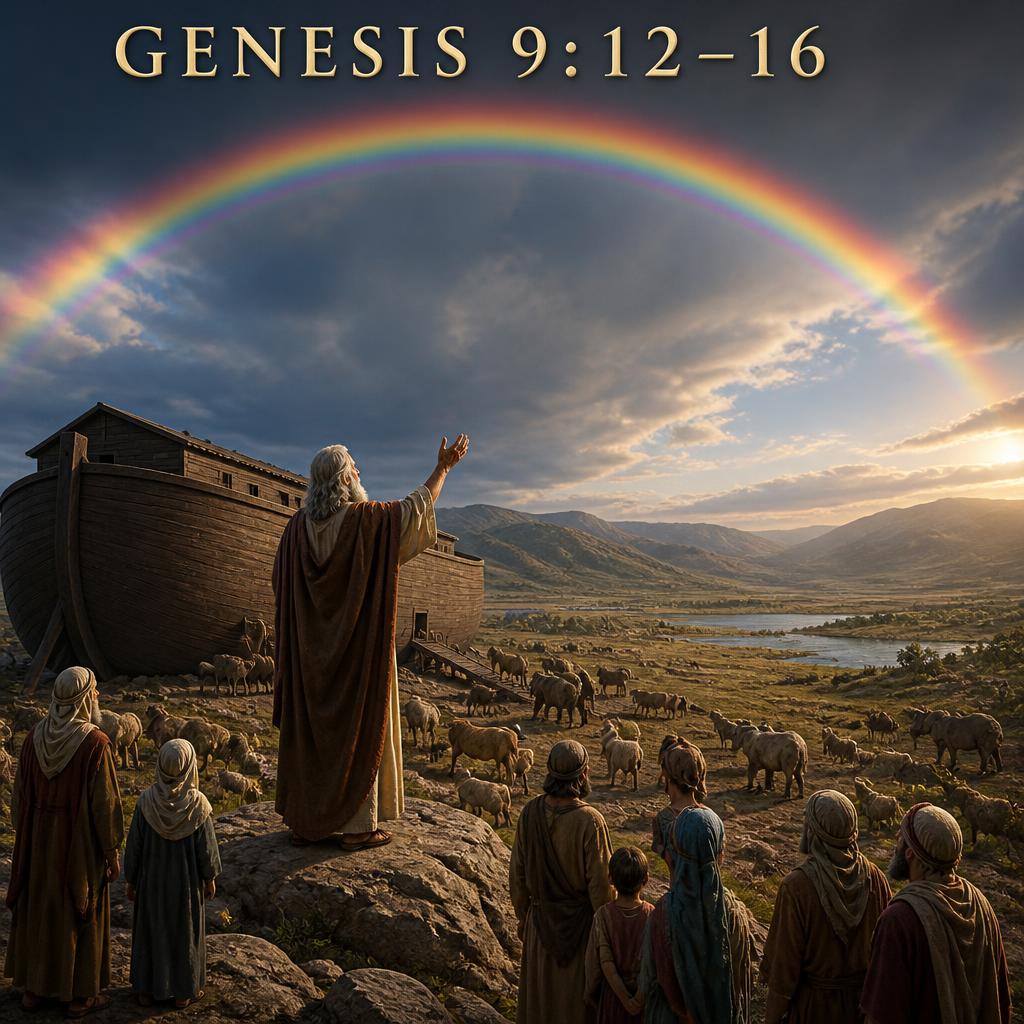
Genesis 9:12–16 records God’s covenant with Noah and with all creation: “I have set my rainbow in the clouds, and it will be the sign of the covenant between me and the earth.” The Hebrew word for rainbow, qeshet, is ordinarily the word for a battle-bow. By choosing this term, God recasts an instrument of war as a symbol of peace—hung unstrung in the clouds, pointing away from the earth and toward heaven.
This covenant is unconditional. Unlike later bilateral covenants, the Noahic covenant rests solely on God’s initiative, guaranteeing stability for “all flesh”. The rainbow is visible to believer and unbeliever alike—an ever-present testimony to God’s mercy. It memorializes past judgment, guarantees present stability, and announces future hope.
The sign of the covenant is not a reminder to humanity first of all. According to the text, the rainbow causes God to remember His covenant (Genesis 9:16). Grace is secured not by our memory of God but by God’s memory of His own promise.
God’s Plan for Every Nation: Grace Without Borders
Genesis 10:32 concludes the Table of Nations: “These are the clans of Noah’s sons, according to their lines of descent, within their nations. From these the nations spread out over the earth after the flood.” The Table of Nations is not an incidental genealogy. It is a theological declaration that all humanity—every tribe, language, and people—traces its origin to the one family preserved through the flood.
The apostle Paul builds directly on this in Acts 17:26: “From one man he made every nation of men, that they should inhabit the whole earth; and he determined their appointed times and the boundaries of their lands.” Paul’s wording deliberately echoes Genesis 10, establishing one human family through Adam and preserved through Noah. If all share this ancestry, then all bear God’s image, and racism, caste systems, and ethnic pride are condemned. The universal offer of redemption rests on the historicity of a single human family and a single Savior.
This universal scope becomes explicit in Genesis 12:3, where God tells Abraham, “All peoples on earth will be blessed through you.” The New Testament identifies this as the gospel announced in advance. Galatians 3:8 quotes the very heart of that promise—”All nations will be blessed through you”—showing that Paul saw a direct, unbroken line from God’s words to Abraham to the gospel itself. Peter cites the same promise in Acts 3:25–26, tying it to Jesus’ resurrection ministry. The blessing promised to Abraham is salvation: forgiveness, righteousness, and Spirit-indwelt life, received by faith.
From Noah to Abraham to Christ, the trajectory is the same: grace chooses a vessel, preserves it through judgment, seals it with a promise, and then opens the blessing outward to every family of the earth.
The Warning: As It Was in the Days of Noah
Jesus did not treat the story of Noah as a harmless children’s tale. In Luke 17:26 He said, “Just as it was in the days of Noah, so also will it be in the days of the Son of Man.” The parallel is sobering. In Noah’s day, “people were eating and drinking, marrying and being given in marriage” (Luke 17:27)—normal routines lulled society into a false sense of security while judgment approached. Noah, called “a preacher of righteousness” (2 Peter 2:5), warned for 120 years, and the world ignored him.
Jesus draws a direct line from that generation to ours: future humanity will mirror Noah’s generation in moral decline and spiritual indifference. The pattern is predictable: long-suffering patience from God, followed by sudden, decisive intervention. Just as the Ark provided the only means of escape, Christ Himself is the sole refuge from coming wrath.
The warning is not meant to produce fear alone. It is meant to produce faith. Noah believed God’s warning about things “not yet seen” and built the Ark long before the first raindrop fell (Hebrews 11:7). The question for every reader is the same one Noah faced: Will you believe the promise of God and enter the refuge He has provided?
Grace Still Finds Hearts Today
Genesis 6:8 is not merely ancient history. It is a mirror. God still looks for hearts willing to walk with Him when culture rushes the other way. Personal integrity still matters. Faith still acts—taking God at His word even when instructions seem impossible or unpopular.
Noah found favor not because he was flawless, but because grace found him and he responded in faith. The Ark was never the ultimate rescue—it was the shadow of Christ. The rainbow was never the ultimate guarantee—it was the sign of a covenant that points forward to the new covenant sealed in His blood. And the Table of Nations was never the final word—it was the beginning of a plan to bless every family on earth through the Seed of Abraham, Jesus Christ.
The grace that found Noah is the same grace that calls every nation, every tribe, and every person today: “Believe on the Lord Jesus Christ, and you will be saved” (Acts 16:31). As it was in the days of Noah, so it is now. The refuge is open. The promise is sure. Will you enter?
Now thanks be unto God, which always causeth us to triumph in Christ (2 Corinthians 2:14).
God gets His greatest victories out of apparent defeats. Very often the enemy seems to triumph for a little, and God lets it be so; but then He comes in and upsets all the work of the enemy, overthrows the apparent victory, and as the Bible says, "turns the way of the wicked upside down." Thus He gives a great deal larger victory than we would have known if He had not allowed the enemy, seemingly, to triumph in the first place.
The story of the three Hebrew children being cast into the fiery furnace is a familiar one. Here was an apparent victory for the enemy. It looked as if the servants of the living God were going to have a terrible defeat. We have all been in places where it seemed as though we were defeated, and the enemy rejoiced. We can imagine what a complete defeat this looked to be. They fell down into the flames, and their enemies watched them to see them burn up in that awful fire, but were greatly astonished to see them walking around in the fire enjoying themselves. Nebuchadnezzar told them to "come forth out of the midst of the fire." Not even a hair was singed, nor was the smell of fire on their garments, "because there is no other god that can deliver after this sort."
This apparent defeat resulted in a marvelous victory.
Suppose that these three men had lost their faith and courage, and had complained, saying, "Why did not God keep us out of the furnace!" They would have been burned, and God would not have been glorified. If there is a great trial in your life today, do not own it as a defeat, but continue, by faith, to claim the victory through Him who is able to make you more than conqueror, and a glorious victory will soon be apparent. Let us learn that in all the hard places God brings us into, He is making opportunities for us to exercise such faith in Him as will bring about blessed results and greatly glorify His name.
Discover more from My Blog-BesthomeBusiness
Subscribe to get the latest posts sent to your email.