

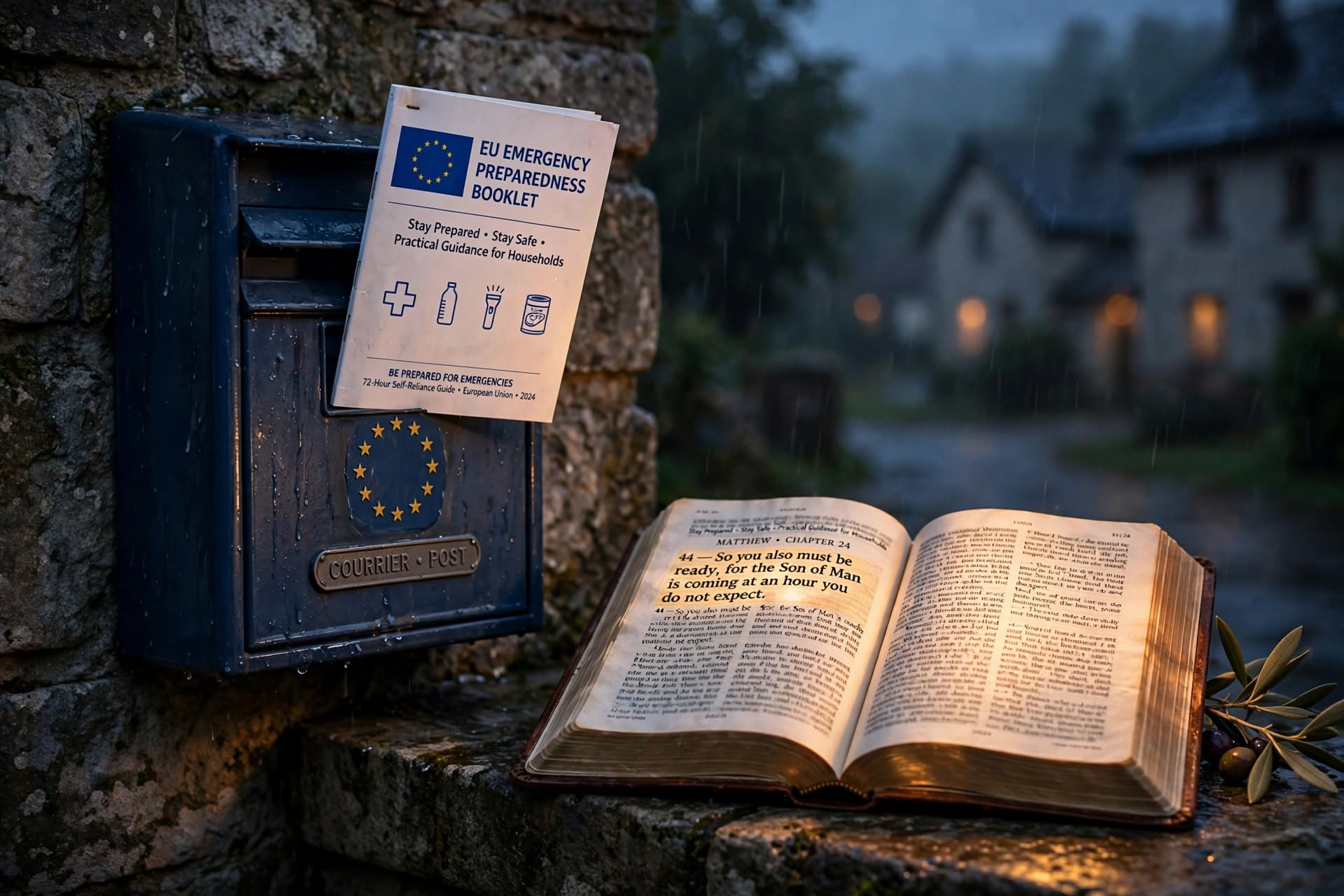
Be Emergency Ready: What a European Booklet Teaches Us About Matthew 24:44
A 17-page booklet has been arriving in mailboxes across Europe, and it is stirring conversations far beyond civil defense. Be Emergency Ready—published by the Irish Department of Defence’s Office of Emergency Planning as part of a broader EU preparedness strategy—urges households to take “simple steps to prepare for emergencies and periods of disruption”. It recommends keeping two to three liters of water per person per day, a battery-operated radio, a physical map, non-perishable food, and copies of important documents in a waterproof bag. Over two million households received it, and the campaign has cost more than €1.2 million.
For Christians, the booklet raises a question that goes deeper than flashlights and water bottles. Jesus said, “Therefore you also must be ready, for the Son of Man is coming at an hour you do not expect” (Matthew 24:44, ESV). What does it mean to be ready—and which readiness matters most right now?
What the Be Emergency Ready Booklet Actually Says
The booklet is not alarmist. It is practical. It outlines three steps: Be aware of potential risks, make a plan for essential supplies, and stay connected with family, neighbors, and trusted sources of information. It advises households to keep a supply of non-perishable food that is regularly rotated, to store documents such as passports and medical information in a waterproof bag, and to have analogue tools like a battery-operated radio and a physical map on hand. The underlying benchmark, drawn from the European Commission’s preparedness strategy, is self-sufficiency for at least 72 hours in an emergency.
The campaign was shaped by real events—Storm Éowyn in January 2025 left 768,000 households without power—and by a wider European focus on “societal resilience and public preparedness” in the face of geopolitical tensions, cyber threats, and climate disruption. In other words, the booklet is a reasonable, measured response to a world that feels increasingly fragile.
And yet, as Christians read it, we should feel a holy tension. The booklet prepares us for disruption. Matthew 24:44 prepares us for arrival.
Matthew 24:44: The Readiness Jesus Commands
Matthew 24:44 sits at the heart of Jesus’ teaching about His return. The verse begins with “For this reason”—pointing back to the sudden, unexpected nature of judgment in the days of Noah and the image of a thief breaking in at night. Jesus is not offering a timeline. He is commanding a posture: “You also must be ready.”
The Greek word behind “ready” carries the sense of being prepared and watchful—a state of active expectation, not passive waiting. Bible commentators consistently emphasize that this readiness is personal (“you also”), continual (“must be”), and moral and spiritual in nature. As one summary puts it, “Readiness means living every day as though Jesus could appear before the next”. The practical marks of that readiness are not stockpiled goods but consistent repentance, active obedience, stewardship of time and gifts, and gathering with other believers.
Here is the crucial distinction: the Be Emergency Ready booklet prepares you for a crisis that might come. Matthew 24:44 prepares you for a Christ who will come. One readiness is temporal and can be measured in liters and batteries. The other is eternal and is measured in faithfulness.
Where the Booklet Gets It Right—and Where It Cannot Go Far Enough
We should not dismiss the booklet. Scripture commends prudent preparation. Proverbs 22:3 says, “The prudent sees danger and hides himself, but the simple go on and suffer for it.” Joseph stored grain during years of plenty (Genesis 41). Jesus Himself acknowledged that a homeowner would have stayed awake if he had known when the thief was coming (Matthew 24:43). Physical preparedness is not a lack of faith; it can be an expression of stewardship and love for family and neighbors.
The booklet’s emphasis on staying connected—with family, neighbors, and local community—also echoes the biblical call to bear one another’s burdens (Galatians 6:2) and to “consider how to stir up one another to love and good works” (Hebrews 10:24). In a culture of isolation, the booklet’s nudge toward neighborliness is a common-grace good.
But the booklet cannot go where Matthew 24:44 goes. It can tell you to keep copies of important documents. It cannot tell you whether your name is written in the Lamb’s book of life. It can tell you to store water. It cannot tell you to store up treasure in heaven. It can prepare you for 72 hours of disruption. It cannot prepare you for the day when “the heavens will pass away with a roar, and the heavenly bodies will be burned up and dissolved” (2 Peter 3:10).
This is not a criticism of the booklet. It is a reminder of its limits. A civil defense pamphlet is not a gospel tract. But the church must be careful not to confuse the two.
What Is Most Important and Current?
The most important and current question is not whether you have three days of water. It is whether you are ready for the return of the Son of Man.
That does not mean we should ignore practical preparation. It means we should reorder it. Physical readiness serves spiritual readiness; it must never substitute for it. A pantry full of non-perishable food is worthless if the pantry-owner has never repented. A waterproof bag of passports and insurance documents is a kindness to your family, but it cannot save your soul.
Matthew 24:44 is current because the same Jesus who spoke it is still coming. The signs around us—wars, rumors of wars, earthquakes, persecution, false prophets, the love of many growing cold (Matthew 24:6–12)—are not reasons to set dates or to panic. They are reasons to watch and to be ready. The European booklet is a small, timely echo of a much larger urgency. It reminds us that disruption is real. The gospel reminds us that deliverance is real too.
How to Be Truly Ready
First, make sure you are in Christ. Readiness begins with the new birth, not with a checklist. Jesus said, “Truly, truly, I say to you, unless one is born again he cannot see the kingdom of God” (John 3:3). If you have never turned from sin and trusted Christ alone for salvation, no amount of emergency supplies will prepare you for what matters most.
Second, live in daily repentance and obedience. Readiness is not a single decision; it is a daily posture. “Prepare your minds for action, and be sober-minded” (1 Peter 1:13). Keep short accounts with God. Obey what you know. Do not drift into the complacency Jesus warned about.
Third, love your neighbor—practically and spiritually. The booklet’s call to stay connected is a discipleship opportunity. Check on the elderly. Share what you have. And as you do, be ready to give a reason for the hope that is in you (1 Peter 3:15). A generator and a spare blanket can open a door for the gospel. Use them.
Fourth, hold your preparations loosely. “Some preparation is better than no preparation at all,” the booklet says. True. But do not let preparation become your functional savior. Do not let fear drive you. “God gave us a spirit not of fear but of power and love and self-control” (2 Timothy 1:7).
A Prayer for Readiness
Lord Jesus, You are coming at an hour we do not expect. Make us ready—not merely with supplies, but with hearts that are watching, repentant, and faithful. Help us to prepare wisely for the disruptions of this world without ever forgetting that our ultimate readiness is found in You alone. Keep us awake. Keep us holy. Keep us hopeful. Amen.
The Be Emergency Ready booklet will help you through a storm. Matthew 24:44 will help you through the door of eternity. Be ready—both.
Now thanks be unto God, which always causeth us to triumph in Christ (2 Corinthians 2:14).
God gets His greatest victories out of apparent defeats. Very often the enemy seems to triumph for a little, and God lets it be so; but then He comes in and upsets all the work of the enemy, overthrows the apparent victory, and as the Bible says, "turns the way of the wicked upside down." Thus He gives a great deal larger victory than we would have known if He had not allowed the enemy, seemingly, to triumph in the first place.
The story of the three Hebrew children being cast into the fiery furnace is a familiar one. Here was an apparent victory for the enemy. It looked as if the servants of the living God were going to have a terrible defeat. We have all been in places where it seemed as though we were defeated, and the enemy rejoiced. We can imagine what a complete defeat this looked to be. They fell down into the flames, and their enemies watched them to see them burn up in that awful fire, but were greatly astonished to see them walking around in the fire enjoying themselves. Nebuchadnezzar told them to "come forth out of the midst of the fire." Not even a hair was singed, nor was the smell of fire on their garments, "because there is no other god that can deliver after this sort."
This apparent defeat resulted in a marvelous victory.
Suppose that these three men had lost their faith and courage, and had complained, saying, "Why did not God keep us out of the furnace!" They would have been burned, and God would not have been glorified. If there is a great trial in your life today, do not own it as a defeat, but continue, by faith, to claim the victory through Him who is able to make you more than conqueror, and a glorious victory will soon be apparent. Let us learn that in all the hard places God brings us into, He is making opportunities for us to exercise such faith in Him as will bring about blessed results and greatly glorify His name.
Discover more from My Blog-BesthomeBusiness
Subscribe to get the latest posts sent to your email.