
The 7 Feasts of Israel: 4 Fulfilled, 3 Awaiting Their Promise
As Israel recently observed Rosh Hashanah—the Jewish New Year of 5787—beginning at sunset on September 11, 2026, the piercing blast of the shofar echoed through synagogues across the nation. For many, this is merely a cultural tradition. But for those who study Scripture, the Feast of Trumpets carries profound prophetic significance. It is one of seven appointed times—moadim in Hebrew—that God established for Israel, each serving as a prophetic blueprint of redemption.
The seven feasts of Israel, outlined in Leviticus 23, are not merely historical observances. They are divine appointments, carefully orchestrated to reveal God’s plan of salvation through His Son, Jesus Christ. The first four feasts were fulfilled precisely and literally during Christ’s first coming. The final three await their fulfillment in connection with His return.
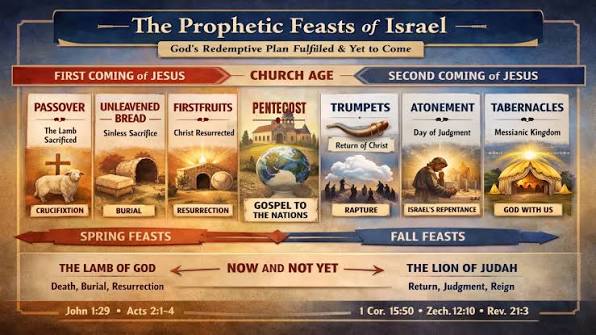
The Seven Feasts at a Glance
The Spring Feasts (Fulfilled):
- Passover – Redemption through the Lamb of God
- Unleavened Bread – The sanctified life of the redeemed
- First Fruits – The resurrection of Christ
- Feast of Weeks (Pentecost) – The coming of the Holy Spirit and the birth of the Church
The Fall Feasts (Awaiting Fulfillment):
- Feast of Trumpets – The call to awakening and the gathering of God’s people
- Day of Atonement (Yom Kippur) – Repentance and national restoration of Israel
- Feast of Tabernacles (Sukkot) – God dwelling with His people in the Millennial Kingdom
The Four Spring Feasts: Fulfilled in Christ
The first four feasts occur in rapid succession during the spring. Their fulfillment in the life, death, and resurrection of Jesus Christ is striking in its precision.
Passover (Leviticus 23:5) speaks of redemption through the blood of the Lamb. Christ, our Passover Lamb, was sacrificed on Passover, delivering believers from the judgment of sin. Just as the blood of a spotless lamb caused God’s judgment to pass over the Israelites in Egypt, so the blood of Jesus causes judgment to pass over all who trust in Him.
The Feast of Unleavened Bread (Leviticus 23:6-8) follows immediately and represents the sanctified life of the redeemed. Leaven in Scripture typically symbolizes sin and corruption. The believer, having been redeemed by the Lamb, is called to a life of separation from sin—a life of sincerity and truth.
The Feast of First Fruits (Leviticus 23:9-14) was fulfilled in the resurrection of Christ. As the first fruits of those who have fallen asleep, Jesus rose from the dead on the day of First Fruits, guaranteeing the future resurrection of all who belong to Him.
The Feast of Weeks, also known as Pentecost (Leviticus 23:15-21), was fulfilled when the Holy Spirit descended upon the disciples in Jerusalem, fifty days after Christ’s resurrection. This feast marks the beginning of the Church—the gathering of believers from both Jews and Gentiles into one body.
The Three Fall Feasts: Awaiting Fulfillment
The fall feasts occur within a fifteen-day period in the seventh month of the Hebrew calendar. Unlike the spring feasts, these have not yet been fulfilled. They point to the consummation of God’s redemptive plan at Christ’s return.
The Feast of Trumpets: The Awakening Blast
The Feast of Trumpets, observed on the first day of Tishri, is the first of the fall feasts and holds particular significance for our present time. In Jewish tradition, it is known as Rosh Hashanah, the civil new year, but its biblical name is Yom Teruah—the Day of Blowing.
The shofar’s call: The central observance of this feast is the blowing of the shofar, a ram’s horn trumpet. The sound serves as a call to spiritual awakening, repentance, and preparation for the Day of Atonement that follows ten days later. In Israel’s history, trumpets were used to gather the people, announce war, and herald the arrival of a king.
The prophetic connection: New Testament Scripture consistently links the return of Christ with the sound of a trumpet. In 1 Thessalonians 4:16-17, Paul writes:
“For the Lord Himself will descend from heaven with a shout, with the voice of an archangel, and with the trumpet of God. And the dead in Christ will rise first. Then we who are alive and remain shall be caught up together with them in the clouds to meet the Lord in the air”.
Similarly, 1 Corinthians 15:51-52 declares that at the last trumpet, the dead will be raised incorruptible, and the living will be changed. The Feast of Trumpets foreshadows this pivotal moment—the gathering of God’s people to Himself.
The Jewish expectation: For centuries, Jewish tradition has assigned several names to this feast that point to its ultimate fulfillment: Yom HaDin (the Day of Judgment), Yom HaZikaron (the Day of Remembrance), and even the wedding day of the Messiah. The “days of awe” that follow, leading to Yom Kippur, picture the judgment and repentance that will precede Christ’s return.
The “day that no one knows”: One of the most remarkable aspects of the Feast of Trumpets is its connection to the phrase “no one knows the day or hour.” Because the feast begins on a new moon, its exact timing historically required observation of the moon’s appearance. This echoes Jesus’ words in Matthew 24:36 about His return. The trumpet will sound at an unexpected moment—but for those who are watching, it is a promised hope.
The Day of Atonement: National Repentance
The Day of Atonement, Yom Kippur, follows ten days after the Feast of Trumpets. In the Old Testament, this was the most solemn day of the year, when the high priest entered the Holy of Holies to make atonement for the sins of the nation.
Prophetically, many believe this feast points to Israel’s national recognition of their Messiah. Zechariah 12:10 declares:
“And I will pour on the house of David and on the inhabitants of Jerusalem the Spirit of grace and supplication; then they will look on Me whom they pierced. Yes, they will mourn for Him as one mourns for his only son”.
This day represents the restoration of Israel—the moment when the nation will recognize Jesus as their rejected Messiah and mourn for Him. While the Church has been reconciled to God through Christ throughout the age, Israel’s corporate recognition awaits the end of the age.
The Feast of Tabernacles: God Dwelling with Man
The final feast, Sukkot or the Feast of Tabernacles, speaks of God dwelling with His people in peace and provision. During this eight-day festival, Israelites build temporary booths (sukkahs) and dwell in them, remembering God’s faithfulness during the wilderness journey.
The prophetic fulfillment of this feast is described in Zechariah 14:16:
“And it shall come to pass that everyone who is left of all the nations which came against Jerusalem shall go up from year to year to worship the King, the LORD of hosts, and to keep the Feast of Tabernacles”.
This feast points to the Millennial Kingdom—the thousand-year reign of Christ on earth, when peace and righteousness will cover the earth as waters cover the sea. It pictures the great harvest of souls, the ingathering of the nations, and God’s permanent dwelling among His people.
The Shofar Still Sounds
As Israel celebrated Rosh Hashanah this September, the shofar’s blast carried across the streets of Jerusalem and echoed through the shops of Mahane Yehuda Market, where pomegranates and honey were stacked high for the sweet new year. For many, it was a time of reflection and renewal, a moment to consider what the year ahead might hold.
But for those who understand the prophetic calendar, the Feast of Trumpets carries a deeper resonance. The four spring feasts were fulfilled with mathematical precision in Christ’s first coming. The three fall feasts await their fulfillment with equal certainty. Just as surely as Christ died on Passover and rose on First Fruits, the trumpet will sound, the Day of Atonement will bring national restoration to Israel, and the Feast of Tabernacles will be celebrated in the Kingdom of the Messiah.
The question is not whether these things will come to pass—but whether we are ready when the shofar sounds.
Now thanks be unto God, which always causeth us to triumph in Christ (2 Corinthians 2:14).
God gets His greatest victories out of apparent defeats. Very often the enemy seems to triumph for a little, and God lets it be so; but then He comes in and upsets all the work of the enemy, overthrows the apparent victory, and as the Bible says, "turns the way of the wicked upside down." Thus He gives a great deal larger victory than we would have known if He had not allowed the enemy, seemingly, to triumph in the first place.
The story of the three Hebrew children being cast into the fiery furnace is a familiar one. Here was an apparent victory for the enemy. It looked as if the servants of the living God were going to have a terrible defeat. We have all been in places where it seemed as though we were defeated, and the enemy rejoiced. We can imagine what a complete defeat this looked to be. They fell down into the flames, and their enemies watched them to see them burn up in that awful fire, but were greatly astonished to see them walking around in the fire enjoying themselves. Nebuchadnezzar told them to "come forth out of the midst of the fire." Not even a hair was singed, nor was the smell of fire on their garments, "because there is no other god that can deliver after this sort."
This apparent defeat resulted in a marvelous victory.
Suppose that these three men had lost their faith and courage, and had complained, saying, "Why did not God keep us out of the furnace!" They would have been burned, and God would not have been glorified. If there is a great trial in your life today, do not own it as a defeat, but continue, by faith, to claim the victory through Him who is able to make you more than conqueror, and a glorious victory will soon be apparent. Let us learn that in all the hard places God brings us into, He is making opportunities for us to exercise such faith in Him as will bring about blessed results and greatly glorify His name.
Discover more from My Blog-BesthomeBusiness
Subscribe to get the latest posts sent to your email.