

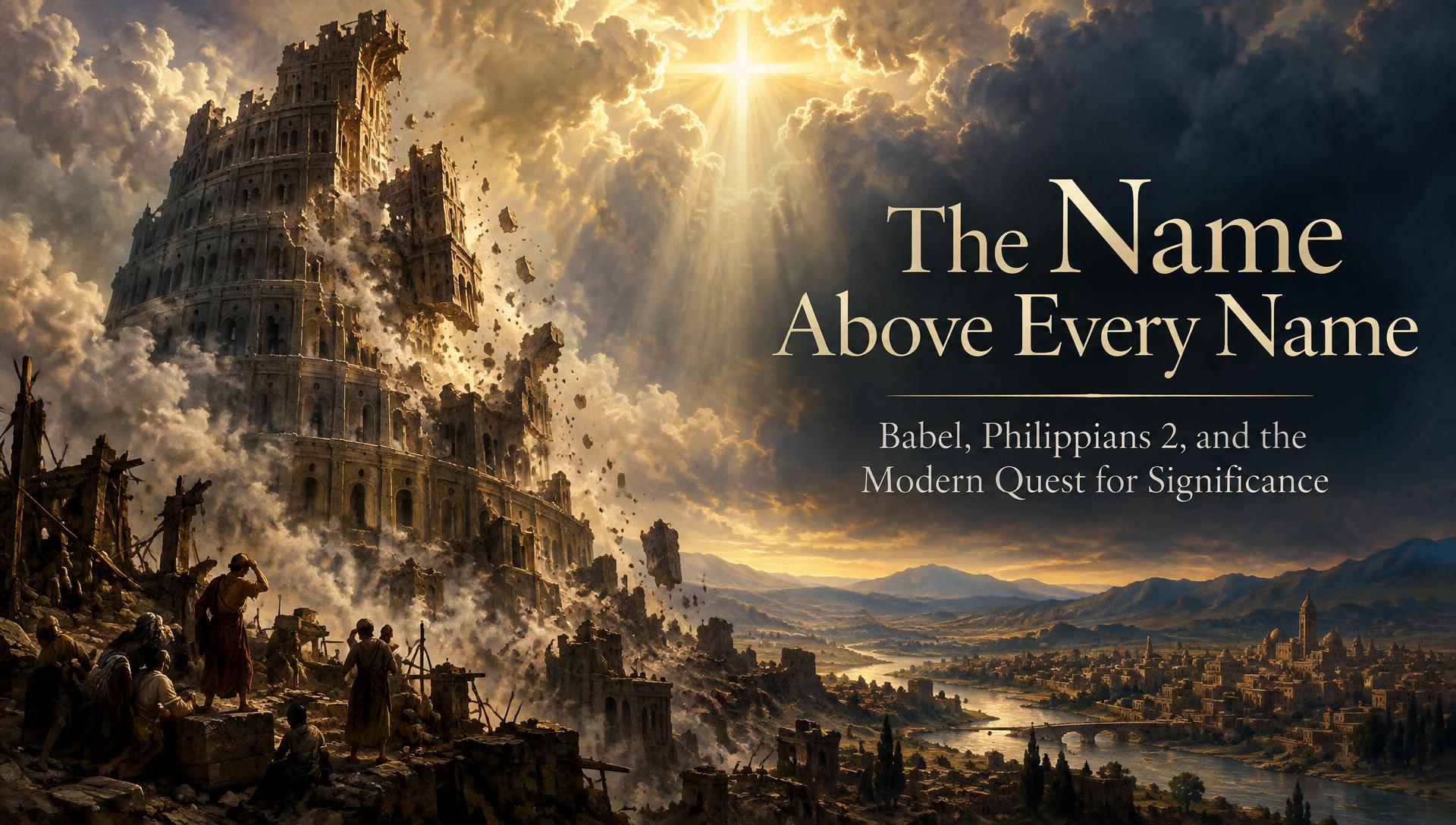
The Name Above Every Name: Babel, Philippians 2, and the Modern Quest for Significance
Two biblical passages, separated by centuries, speak to the same human impulse. In Genesis 11:1–9, a united humanity declares, “Come, let us build ourselves a city, and a tower with its top in the heavens, and let us make a name for ourselves” (v. 4). In Philippians 2:9–11, God does the opposite of what Babel’s builders attempted: “Therefore God has highly exalted him and bestowed on him the name that is above every name, so that at the name of Jesus every knee should bow” (vv. 9–10). One is a story of self-made renown and its collapse. The other is a story of self-emptying humility and its exaltation. And both are startlingly relevant to the age of algorithms, influencers, and artificial intelligence.
Babel: The Anatomy of Self-Made Name
The Babel narrative is often reduced to a story about architectural arrogance or linguistic diversity. But its theological core is the phrase “let us make a name for ourselves.” In the ancient world, a name was not a label; it was a claim about essence, legacy, and permanence. The Babelians wanted a collective name that would secure their future, prevent their scattering, and memorialize their achievement. Their project was not merely technological—it was a bid for quasi-immortality, an attempt to transcend the post-Edenic human condition by securing a legacy on their own terms.
The problem was not unity itself. The problem was a counterfeit unity organized around human pride and autonomy rather than submission to God. God’s response—confusing their language and scattering them—is sometimes read as a punishment. But it is also a mercy. A humanity united in self-exaltation would become a closed system, a fusional social body that leaves no room for diversity, dependence, or grace. The scattering at Babel is a therapy, not merely a judgment: it prevents humanity from consolidating into a monolith that forgets its need for the Name that only God can give.
Philippians 2: The Name That Is Given, Not Grasped
Paul’s hymn in Philippians 2 moves in the opposite direction. Jesus does not grasp at equality with God; he empties himself, takes the form of a servant, and becomes obedient to death on a cross (vv. 6–8). Because of that descent, God exalts him and confers on him “the name that is above every name.” In biblical language, a name reveals a person’s true essence and function. The name given to Jesus is Kyrios—“Lord”—the title used in the Greek Old Testament for the sacred, unutterable name of God himself. Jesus receives by grace what Babel tried to seize by force.
The contrast could not be sharper. Babel says, “Let us make a name for ourselves.” Philippians says, “God gave him the name.” Babel’s name is self-generated, collective, and anxious. Jesus’ name is bestowed by the Father, personal, and secure. Babel’s project ends in confusion. Jesus’ obedience ends in universal acclamation: every knee bows and every tongue confesses that Jesus Christ is Lord, to the glory of God the Father (vv. 10–11). The one who did not grasp for a name receives the Name above every name—and in that Name, the scattered nations of Babel find their true unity.
The Modern Babel: Algorithms, Influencers, and AI
We no longer build towers of brick and bitumen, but the impulse to “make a name for ourselves” has not disappeared. It has simply migrated to new platforms. Social media has turned self-branding into a daily labor: we curate an image, optimize for visibility, and compete for the currency of attention. Influencer culture promises that if we accumulate enough followers, likes, and verification badges, we will finally have a name that matters. The result, all too often, is the same anxiety that drove Babel’s builders: an identity built on performance, vulnerable to every shift in the algorithm.
The digital age has also produced what some theologians and cultural critics are calling a new digital Babel. The uniform languages of the platform—the same outrage dialect, the same viral formats, the same optimization logic—create an illusion of cohesion while flattening difference and diluting identity. Social media can become an anti-Pentecost: millions speaking the same idiom of indignation without genuinely understanding one another. And now artificial intelligence promises to solve the “curse of Babel” by translating every language and generating endless content. Babel was built with “a single language, a single technology, a single direction”—and the deeper problem was not technological achievement but communication detached from humility, solidarity, and the common good. Faster communication is not the same as better communication. Fluency is not wisdom.
The Name We Actually Need
The gospel does not call us to reject technology, creativity, or the desire to be known. It calls us to reorder that desire. The Babel impulse says: make a name for yourself, and then you will be safe. The Philippian hymn says: you already have a name—given, not earned—and it is the name of the One who humbled himself for you. Baptism, not the algorithm, is where identity is conferred. We are named as beloved sons and daughters before we accomplish anything, and that name cannot be taken away by obscurity, failure, or a decline in engagement.
This is not an abstract theological point. It is a daily practice. When we choose humility over self-promotion, when we listen rather than perform, when we refuse to build a personal tower at the expense of others, we are learning to live under the Name above every name. Babel’s unity crumbles because it is held together by ambition. The unity that Christ creates is different: it is a unity of diverse people who do not need to erase their differences because they are centered on the One who is Lord of all. At the name of Jesus, every knee will bow—not because we finally made a name for ourselves, but because the Name was given to the One who emptied himself for us.
Now thanks be unto God, which always causeth us to triumph in Christ (2 Corinthians 2:14).
God gets His greatest victories out of apparent defeats. Very often the enemy seems to triumph for a little, and God lets it be so; but then He comes in and upsets all the work of the enemy, overthrows the apparent victory, and as the Bible says, "turns the way of the wicked upside down." Thus He gives a great deal larger victory than we would have known if He had not allowed the enemy, seemingly, to triumph in the first place.
The story of the three Hebrew children being cast into the fiery furnace is a familiar one. Here was an apparent victory for the enemy. It looked as if the servants of the living God were going to have a terrible defeat. We have all been in places where it seemed as though we were defeated, and the enemy rejoiced. We can imagine what a complete defeat this looked to be. They fell down into the flames, and their enemies watched them to see them burn up in that awful fire, but were greatly astonished to see them walking around in the fire enjoying themselves. Nebuchadnezzar told them to "come forth out of the midst of the fire." Not even a hair was singed, nor was the smell of fire on their garments, "because there is no other god that can deliver after this sort."
This apparent defeat resulted in a marvelous victory.
Suppose that these three men had lost their faith and courage, and had complained, saying, "Why did not God keep us out of the furnace!" They would have been burned, and God would not have been glorified. If there is a great trial in your life today, do not own it as a defeat, but continue, by faith, to claim the victory through Him who is able to make you more than conqueror, and a glorious victory will soon be apparent. Let us learn that in all the hard places God brings us into, He is making opportunities for us to exercise such faith in Him as will bring about blessed results and greatly glorify His name.
Discover more from My Blog-BesthomeBusiness
Subscribe to get the latest posts sent to your email.

Related Posts

The Illusion of Control: Finding Your True Direction in Jeremiah 10:23 and John 15:5

God’s Grace in Genesis: How Noah Found Favor and What It Means for You