
The Illusion of Control: Finding Your True Direction in Jeremiah 10:23 and John 15:5
The Illusion of Control: Finding Your True Direction in Jeremiah 10:23 and John 15:5
We live in a world that champions self-determination. The cultural mantra is clear: “You can be anything you want to be,” “Chart your own course,” and “Take control of your destiny.” From a young age, we are taught to map out our lives, set five-year plans, and rely on our own ingenuity to navigate the complexities of existence. Yet, for the follower of Jesus, this pervasive mindset stands in stark contradiction to the fundamental posture of the Christian life. The Bible presents a radically different reality—one that is both humbling and profoundly liberating.
This tension between self-reliance and divine dependence is beautifully and powerfully illustrated when we place two passages of Scripture side-by-side: a prayer of the Old Testament prophet Jeremiah and a metaphor spoken by Jesus Christ Himself. Though separated by centuries, Jeremiah 10:23 and John 15:5 speak with one unified voice, revealing our absolute need for God’s guidance and the fruitfulness that flows from a life rooted in Him.
The Honest Confession: “The Way of Man Is Not in Himself”
Our journey begins with a startling admission from the prophet Jeremiah. In the midst of his lament over the impending judgment of Judah, he pauses to articulate a foundational truth about human nature: “O LORD, I know that the way of man is not in himself; it is not in man who walks to direct his steps” (Jeremiah 10:23, NKJV).
This is not a statement of mere philosophical speculation; it is a profound confession of dependence. Jeremiah is not speaking only for himself. He gives voice to the “better elements of thought and feeling” among the nation, acknowledging their “conscious shortsightedness” and their “helpless dependence on the unseen Divine power”. The prophet recognizes that all of human life is a journey, a pilgrimage through scenes and circumstances that we do not fully control. Despite our illusions of autonomy, we are not the ultimate masters of our fate.
Jeremiah’s confession highlights two critical realities. First, it points to a moral inability. A man’s own judgment and impulse are not a safe guide for life. The prophet understood that we are liable to be deceived by appearances, blinded by our own feelings, and misled by self-will. The very complexity of the paths we walk often becomes a source of danger, and we need guidance that is external to and greater than ourselves. Second, it points to a practical restraint. We are not always the masters of our own movements. We can make our plans, but we often find ourselves constrained by circumstances beyond our control, “drifted by the silent, unobserved current of events” into positions we would never have chosen. As the old proverb goes, “Man proposes; God disposes”.
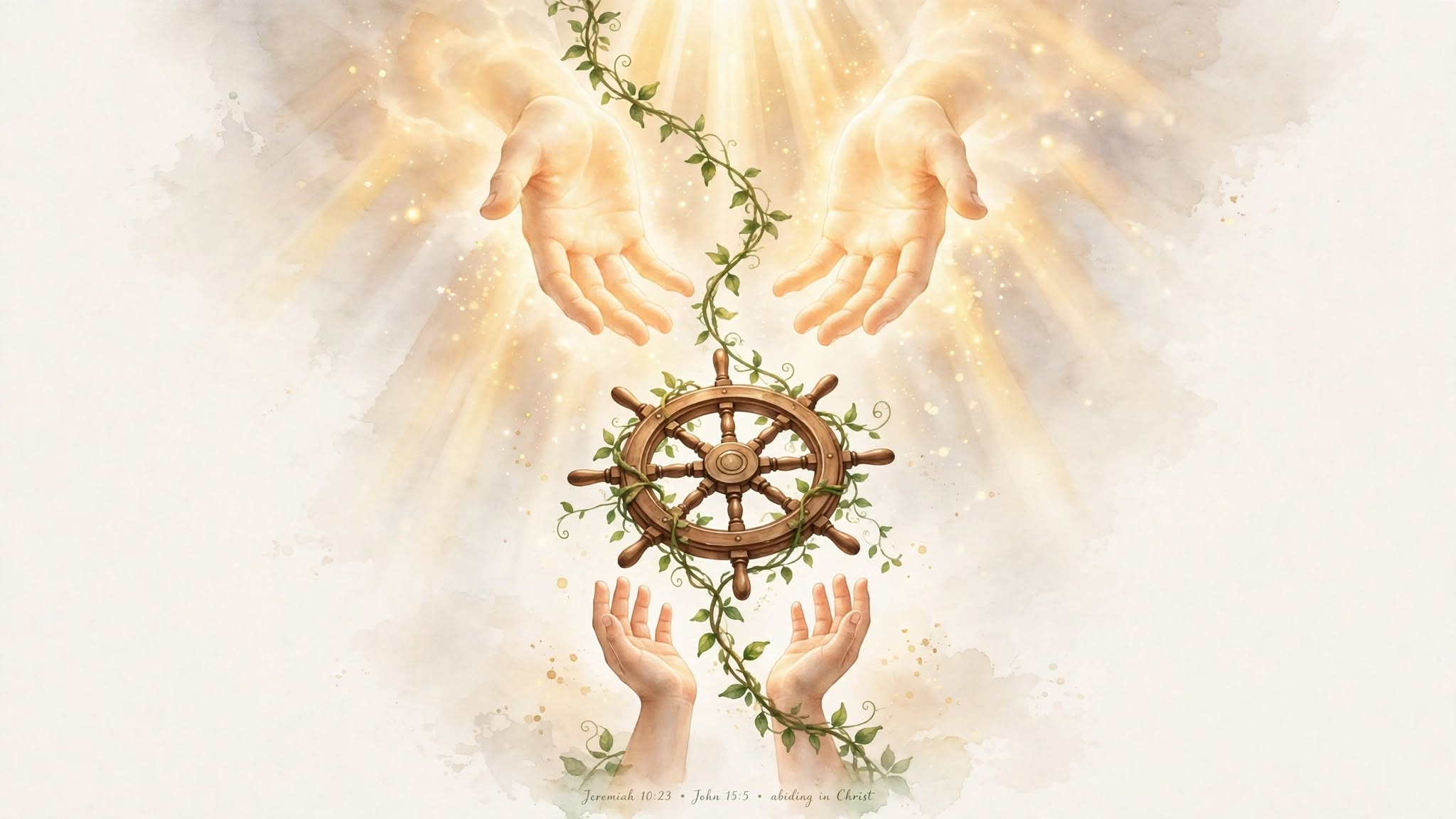
The essence of Jeremiah’s prayer is the shattering of the illusion of self-sufficiency. It is the recognition that trying to steer the ship of our lives with our own limited wisdom is not only foolish but also perilous. The prophet Jeremiah, who knew from his own experience the weight of a calling he did not choose, understood that the way of safety, peace, and true happiness is found only in strict compliance with the Divine will. His confession is a necessary first step: we must admit that we cannot direct our own steps before we can ever be led by God.
The Divine Solution: “I Am the Vine”
If Jeremiah 10:23 diagnoses the human condition—our inherent inability to guide ourselves—then John 15:5 provides the divine prescription. In the upper room, on the night before His crucifixion, Jesus speaks words of profound comfort and clarity to His disciples: “I am the vine, you are the branches. He who abides in Me, and I in him, bears much fruit; for without Me you can do nothing” .
Here, Jesus uses the rich Old Testament imagery of the vineyard. Throughout Scripture, Israel had been depicted as God’s vine, planted and tended by Him (see Psalm 80, Isaiah 5). Yet, Israel repeatedly failed to bear the righteousness God desired. In a stunning declaration, Jesus announces that He is the true Vine, the perfect fulfillment of what Israel could not be. He is the single, living source of spiritual life.
This metaphor is intensely practical. A branch does not sustain itself; it simply receives. It has no life of its own. Its only function is to remain connected to the vine, from which it draws all the sap—the life, the nutrients, the very power to produce fruit. Union with Christ is not a mere outward association; it is a living, organic relationship in which His life sustains, strengthens, and directs the believer.
The key word in John 15 is “abide.” To “remain” or “abide” in Christ describes a settled, ongoing relationship. It is not a momentary feeling but a persevering posture of trust, obedience, and dependence. It involves continuing faith, dependence on His Word, and love for His people. And then comes the stark, bottom-line reality: “apart from Me you can do nothing” . Human strength, religious activity, and natural ability cannot produce spiritual life or fruit that endures before God. Every work that truly honors God depends entirely on Christ’s power and grace.
The Beautiful Intersection: From Striving to Abiding
When we read these two verses together, a powerful theological truth emerges. John 15:5 is the answer to the problem articulated in Jeremiah 10:23. Jeremiah confesses, “I cannot direct my own steps.” Jesus responds, “I am the way. Stay connected to Me, and I will direct them. Apart from Me, you can do nothing.” The Old Testament prophet exposes the bankruptcy of self-rule; the Son of God offers the abundant life of surrendered dependence.
The connection is not merely thematic; it is deeply theological. Both passages call us to abandon self-reliance. The branch does not strain and strive to produce fruit through its own effort. It simply abides. The fruit is the inevitable, organic result of the life of the vine flowing through it. As one devotional writer puts it, you cannot tie apples onto the branches of a dead tree; spiritual fruit is not the product of human effort but the result of the life of Christ within us.
This is the secret to a fruitful and directed life. It is not about trying harder to be a good person or mustering up the willpower to follow God’s plan. It is about cultivating a deep, abiding connection with Jesus. The Christian life is not mere imitation of Christ; it is participation in His very life. Abiding means living with a continual, conscious awareness of His presence, depending on His Word, and allowing His life to flow through you. When we do this, the promise is clear: we will bear much fruit. Fruitfulness is the inevitable evidence of a genuine, living relationship with Christ.
A Prayer for Surrender
This truth is not meant to remain abstract; it demands a response. The path forward is not one of anxious striving but of humble surrender. It begins with a prayer like Jeremiah’s: “Lord, I know that I cannot direct my own steps. I surrender my plans, my ambitions, and my desire for control to You.”
Then, it continues with a daily, moment-by-moment choice to abide in Christ. This is not a passive resignation but an active, deliberate pursuit of intimacy with Him through prayer, Scripture, and obedience. When we are tempted to take back the reins of our lives, we remember the branch’s total dependence on the vine. When we feel the pressure to produce results, we remember that fruit is His work, not ours.
The life you are longing for—a life of purpose, direction, and lasting fruit—is not found in a better plan or a stronger willpower. It is found in a Person. It is found in the True Vine. Let us stop trying to direct our own steps and instead, day by day, moment by moment, choose to abide.
Now thanks be unto God, which always causeth us to triumph in Christ (2 Corinthians 2:14).
God gets His greatest victories out of apparent defeats. Very often the enemy seems to triumph for a little, and God lets it be so; but then He comes in and upsets all the work of the enemy, overthrows the apparent victory, and as the Bible says, "turns the way of the wicked upside down." Thus He gives a great deal larger victory than we would have known if He had not allowed the enemy, seemingly, to triumph in the first place.
The story of the three Hebrew children being cast into the fiery furnace is a familiar one. Here was an apparent victory for the enemy. It looked as if the servants of the living God were going to have a terrible defeat. We have all been in places where it seemed as though we were defeated, and the enemy rejoiced. We can imagine what a complete defeat this looked to be. They fell down into the flames, and their enemies watched them to see them burn up in that awful fire, but were greatly astonished to see them walking around in the fire enjoying themselves. Nebuchadnezzar told them to "come forth out of the midst of the fire." Not even a hair was singed, nor was the smell of fire on their garments, "because there is no other god that can deliver after this sort."
This apparent defeat resulted in a marvelous victory.
Suppose that these three men had lost their faith and courage, and had complained, saying, "Why did not God keep us out of the furnace!" They would have been burned, and God would not have been glorified. If there is a great trial in your life today, do not own it as a defeat, but continue, by faith, to claim the victory through Him who is able to make you more than conqueror, and a glorious victory will soon be apparent. Let us learn that in all the hard places God brings us into, He is making opportunities for us to exercise such faith in Him as will bring about blessed results and greatly glorify His name.
Discover more from My Blog-BesthomeBusiness
Subscribe to get the latest posts sent to your email.