
The Scroll and the Savior: Unlocking the Mystery of Revelation 5:2-5
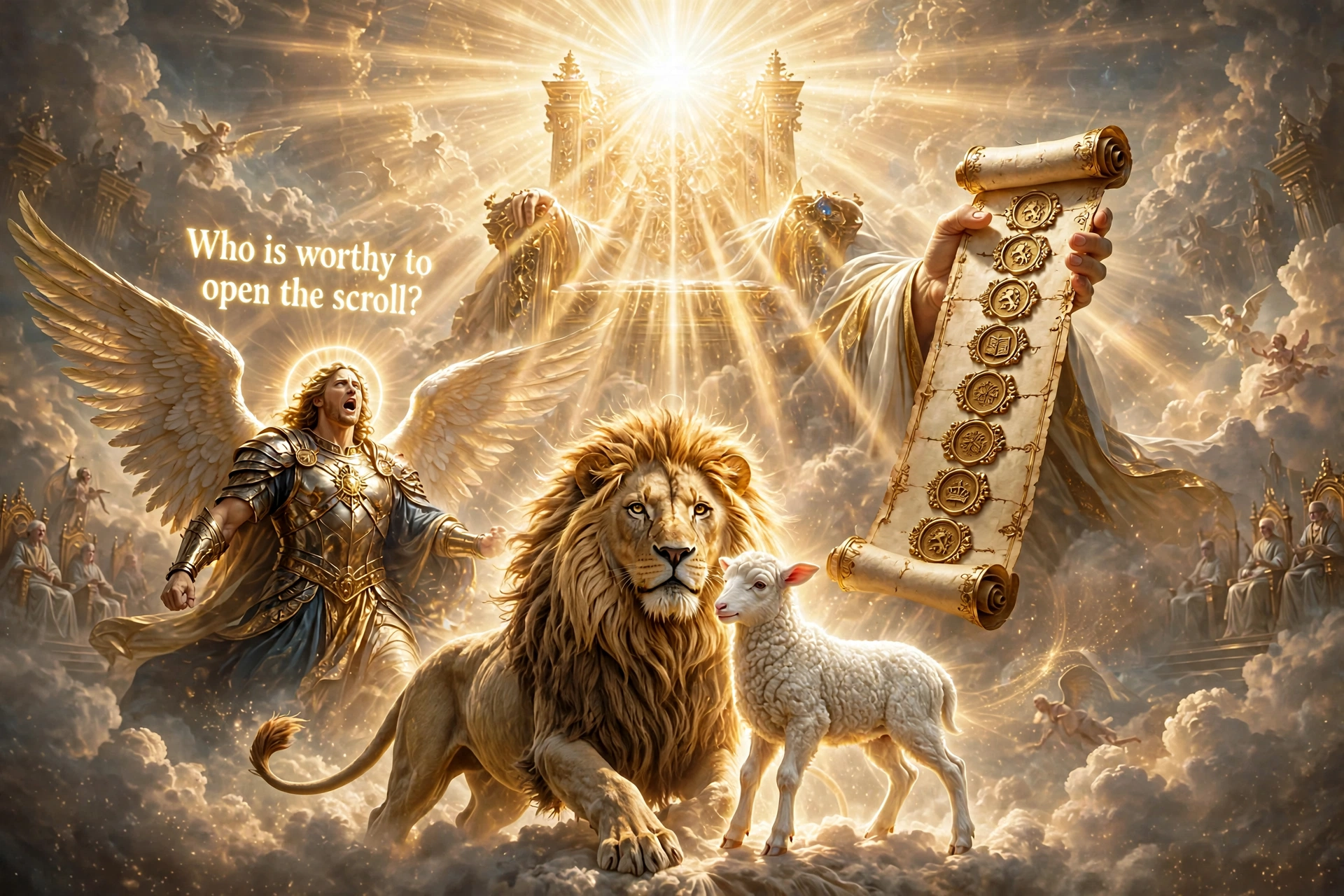
In the grand, sweeping vision of the Apocalypse, the Apostle John finds himself transported to the throne room of heaven. The atmosphere is charged with the majesty of God, lightning flashes, and thunder peals. Yet, amidst this overwhelming glory, a crisis emerges that brings the heavenly court to a standstill. In Revelation 5:2-5, we encounter one of the most dramatic and theologically dense moments in all of Scripture. A mighty angel poses a question that echoes through eternity: “Who is worthy to open the scroll and break its seals?”
For John, the answer initially is devastating. No one is found worthy. He weeps loudly. But then, a voice of comfort cuts through the despair, pointing to the Lion of Judah, the Root of David, who has triumphed. To understand the depth of this passage, we must ask two critical questions: What exactly is this book with the seven seals? And why did the opening of it require someone uniquely worthy?
The Context of the Heavenly Courtroom
To grasp the weight of Revelation 5, we must look at the preceding chapter. Revelation 4 depicts God the Father seated on the throne, holding a scroll in His right hand (Revelation 5:1). This scroll is written on both sides and sealed with seven seals. In the ancient world, a document written on both sides (a opisthograph) indicated that the contents were comprehensive and complete—leaving no room for additional information. The seven seals, meanwhile, signify absolute authority, security, and the severity of the judgment contained within.
What IS the Book with the Seven Seals?
Theologians have debated the nature of this scroll for centuries, but the text gives us robust clues. This is not merely a “book” in the modern sense of a novel or a historical chronicle. Rather, it represents two profound realities:
1. The Title-Deed to the Earth and Human History
In ancient Roman law, a sealed scroll often served as a legal document—a will, a contract, or a property deed. The seven seals acted as a legal safeguard. When Adam sinned in the Garden of Eden, he forfeited the dominion and authority over creation that God had given him (Genesis 1:28). Humanity effectively “lost the deed” to the earth, handing it over to the usurper—Satan. The scroll in God’s hand is the legal title-deed to the universe. It holds the plan for the redemption of the earth, the judgment of evil, and the restoration of God’s rightful rule. Until the seals are broken, the inheritance cannot be claimed, and the final judgment cannot commence.
2. The Unveiling of God’s Redemptive Plan
The scroll contains the prophetic unfolding of the end of the age. The breaking of each seal unleashes a specific event—the Four Horsemen, martyrdom, cosmic disturbances, and ultimately, the silence before the wrath of God (Revelation 6-8). It is the script for the final act of the cosmic drama. It is the answer to the prayer, “Your kingdom come, Your will be done, on earth as it is in heaven.” It is the blueprint for the eradication of sin and the liberation of creation from its bondage to decay (Romans 8:21).
The Great Crisis: “No One Was Found Worthy”
The angel’s challenge in verse 2 is searching: “Who is worthy?” He is not asking for someone who is merely strong or clever. The Greek word used here is axios, which denotes moral weight, legal merit, and intrinsic value. The requirements for opening this scroll are absolute. To open it, one must possess the legal authority to execute judgment, the moral purity to carry it out without sin, and the redemptive power to save the people of God.
Verse 3 delivers a crushing blow: “But no one in heaven or on earth or under the earth could open the scroll or even look inside it.” This encompasses all of creation. The angels, the patriarchs, the prophets, the martyrs—none qualified. It wasn’t that they were bad people; they were flawed. They were sons of Adam, tainted by the original sin. They had no legal standing to reclaim what Adam lost. John, the beloved disciple, breaks down. His weeping is not mere sadness; it is the lament of all creation. If the scroll remains sealed, sin remains unpunished, death remains undefeated, and humanity remains separated from God. The silence in heaven is the silence of hopelessness.
The Solution: The Lion Who is a Lamb
Just as despair reaches its peak, one of the twenty-four elders intervenes. He tells John to stop weeping. Then, in verse 5, he utters one of the most powerful messianic declarations in the Bible: “See, the Lion of the tribe of Judah, the Root of David, has triumphed. He is able to open the scroll and its seven seals.”
Here, John expects a roaring, conquering King—a militaristic Messiah. The “Lion of Judah” is a direct reference to Genesis 49:9-10, where Jacob prophesies that the scepter will not depart from Judah. “The Root of David” points back to Isaiah 11:1, promising a shoot from the stump of Jesse who will rule with righteousness. This is the language of a king, a conqueror, a warrior.
But when John turns to look at this Lion, what does he see? In verse 6, he sees a Lamb, “looking as if it had been slain.” The ultimate power in the universe is not raw, military force; it is sacrificial love. The “triumph” (or “overcoming”) of Jesus was achieved not on a warhorse, but on a Roman cross.
Why One Worthy Had to Open the Book
So, why did the opening of this cosmic book require a specifically “worthy” individual? The answer lies in the confluence of three profound theological principles:
1. The Legal Principle of the Kinsman Redeemer (Goel)
In the Old Testament, the Goel (kinsman-redeemer) was a close relative who had the right to buy back property or a relative from slavery (Leviticus 25:25; Ruth 3-4). To redeem the earth, the redeemer had to be a kinsman—a part of humanity. God became flesh in Jesus Christ (John 1:14). He is our brother, bone of our bone. Furthermore, the redeemer had to be able to pay the price. Jesus paid the ransom price for humanity—not with gold, but with His own blood. Because He is fully man, He qualifies to represent us. Because He is fully God, His sacrifice carries infinite value.
2. The Principle of Legal Righteousness
Sin legally forfeits the right to rule. Adam was the federal head of humanity; when he fell, all fell. Jesus is the “Second Adam” (Romans 5:12-21). Unlike the first Adam, who failed, Jesus was perfectly obedient unto death. He fulfilled the Law of God entirely. His worthiness is not just about His deity; it is about His righteousness. He is the only human being who ever lived a life of absolute perfection. Therefore, He is the only human being with the legal standing to receive the scroll and execute its decrees without being subject to its judgment.
3. The Principle of Redemptive Authority
Notice the elder doesn’t say He is worthy just because He is God. He says He is worthy because He has “triumphed” or “overcome.” Jesus’ victory is twofold. First, He overcame the world (John 16:33). Second, and most importantly, He overcame death itself. Through the resurrection, Jesus conquered the last enemy (1 Corinthians 15:26). The seals on the scroll represent the wrath and curse of God against sin. Jesus willingly took that curse upon Himself. He is the only one who can break the seals of judgment because He has already absorbed that judgment for His people. He earned the right to end the world because He died to save the world.
The Paradox of Power
The message of Revelation 5:2-5 is the ultimate reversal of human expectations. The world expects power through violence, wealth, and political dominance. God’s power is revealed through a slaughtered Lamb. The only one fit to execute the apocalyptic judgments is the one who suffered the ultimate injustice.
For the believer, this is the bedrock of our hope. When we see the chaos of the world—the wars, the famines, the plagues, the persecution—we do not look to politicians or armies for final relief. We look to the Lamb. The seals are in His hands. History is not spiraling out of control; it is meticulously unfolding according to the plan of the One who loves us. He is worthy to open the book, and He is worthy to bring history to its preordained, glorious conclusion.
Conclusion: The Call to Worship
When John sees the Lamb take the scroll, the response of heaven is immediate and overwhelming. The four living creatures and the twenty-four elders fall down in worship. Their song echoes through eternity: “You are worthy to take the scroll and to open its seals, because you were slain, and with your blood you purchased for God persons from every tribe and language and people and nation.” (Rev 5:9).
The question posed by the angel is not just for John; it is for us. Who is worthy to guide our lives? Who is worthy to judge the world? Who is worthy to receive our ultimate trust? The answer is clear. Only Jesus. He is the Lion who conquered by being the Lamb who died. He holds the keys to death, hell, and the grave, and He holds the destiny of humanity in His hands. We can rest secure knowing that the book is open, the plan is in motion, and the King is on His throne.
Now thanks be unto God, which always causeth us to triumph in Christ (2 Corinthians 2:14).
God gets His greatest victories out of apparent defeats. Very often the enemy seems to triumph for a little, and God lets it be so; but then He comes in and upsets all the work of the enemy, overthrows the apparent victory, and as the Bible says, "turns the way of the wicked upside down." Thus He gives a great deal larger victory than we would have known if He had not allowed the enemy, seemingly, to triumph in the first place.
The story of the three Hebrew children being cast into the fiery furnace is a familiar one. Here was an apparent victory for the enemy. It looked as if the servants of the living God were going to have a terrible defeat. We have all been in places where it seemed as though we were defeated, and the enemy rejoiced. We can imagine what a complete defeat this looked to be. They fell down into the flames, and their enemies watched them to see them burn up in that awful fire, but were greatly astonished to see them walking around in the fire enjoying themselves. Nebuchadnezzar told them to "come forth out of the midst of the fire." Not even a hair was singed, nor was the smell of fire on their garments, "because there is no other god that can deliver after this sort."
This apparent defeat resulted in a marvelous victory.
Suppose that these three men had lost their faith and courage, and had complained, saying, "Why did not God keep us out of the furnace!" They would have been burned, and God would not have been glorified. If there is a great trial in your life today, do not own it as a defeat, but continue, by faith, to claim the victory through Him who is able to make you more than conqueror, and a glorious victory will soon be apparent. Let us learn that in all the hard places God brings us into, He is making opportunities for us to exercise such faith in Him as will bring about blessed results and greatly glorify His name.
Discover more from My Blog-BesthomeBusiness
Subscribe to get the latest posts sent to your email.