
The Ancient Call That Wakes the Modern Soul: Repentance and the Kingdom Today
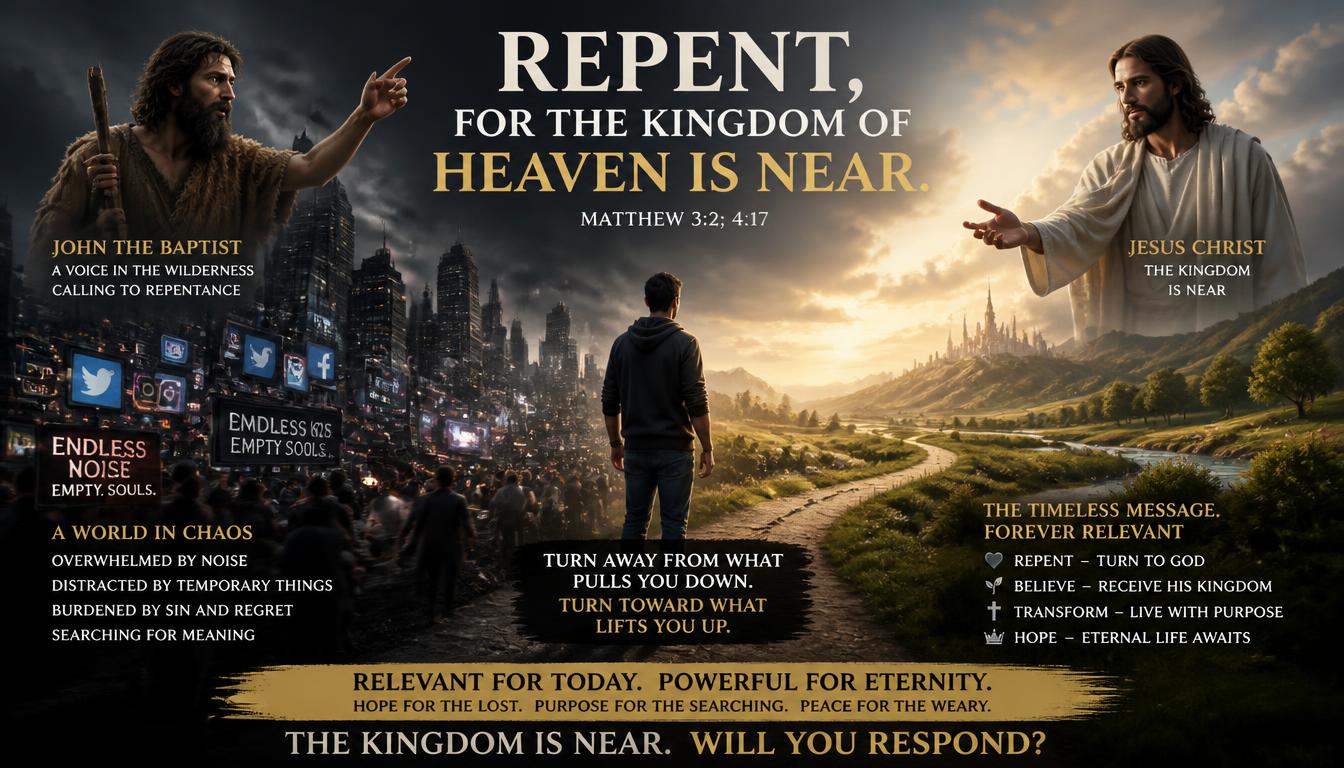
In the quiet, sun-scorched expanse of the Judean wilderness, a voice cried out. It was a voice that didn’t seek to soothe, but to shake; not to comfort, but to challenge. This was the voice of John the Baptist, and his opening salvo was a thunderclap that echoed through the ages: “Repent, for the kingdom of heaven has come near” (Matthew 3:2).
A short time later, as Jesus Christ began his own public ministry, he took up the very same refrain: “Repent, for the kingdom of heaven has come near” (Matthew 4:17).
At first glance, this message might seem like a relic of a bygone era, a dusty phrase from an ancient book with little relevance to our modern lives. We live in an age of unprecedented technological advancement, medical breakthroughs, and global connectivity. The concerns of a first-century Galilean peasant feel a world away from the anxieties of a 21st-century professional. Yet, if we listen closely, the urgency of this ancient call is perhaps more relevant today than ever before. It speaks directly to the deep, unspoken needs of the human heart—the longing for meaning, the burden of a fractured world, and the hope for a new way of being.
Decoding the Ancient Word: What Does “Repent” Really Mean?
To understand the modern application, we must first understand the original language. The Greek word often translated as “repent” is metanoia. It is far richer and more profound than our English word, which often implies mere sorrow or regret for wrongdoing. Metanoia literally means a “change of mind” or a “transformation of consciousness.”
It is not simply feeling bad about a past mistake; it is a radical reorientation of the entire self. It is the act of turning away from an old, broken path and setting your face toward a new, living way. It is seeing the world, yourself, and your relationship with God and others through completely new eyes. This is a universal human experience that transcends religious labels. It is the moment an addict decides to seek recovery, the instant a person in a toxic relationship finally chooses to walk away, or the day a career-driven executive realizes that chasing status has left them feeling empty.
John’s call to repentance was a call to prepare the way, to clear the debris from the path of the soul, because something—or Someone—was arriving. It was an invitation to stop building walls and to start making a road.
The Kingdom’s Arrival: A New Reality Now
The second part of the message, “the kingdom of heaven has come near,” is the answer to the first question. The call to repent is not a moralistic nagging; it is a response to good news. The “kingdom of heaven” is not a far-off place we go to when we die. In Jesus’ teaching, it is the present, active reign of God. It is the invasion of heaven into earthly reality. It is the healing of the sick, the liberation of the oppressed, the forgiveness of sins, and the restoration of all things.
When Jesus says the kingdom is “at hand,” he is announcing a new era. He is the King, and in his presence, the old order of sin, death, and brokenness is being challenged and overthrown. This is not a political revolution in the way we might imagine, but a radical spiritual and social revolution that begins in the heart and ripples outward.
A Mirror to Modern Life: The Urgency of Today
This combined message of metanoia and the kingdom’s nearness is a direct counterpoint to the prevailing spirits of our age.
1. The Exhaustion of the Self-Help Cycle:
Our culture is saturated with self-help. We are told that the key to happiness is more productivity, better fitness, greater wealth, and stronger personal brands. We are constantly encouraged to look inward, to improve ourselves, and to maximize our potential. Yet, despite all our striving, we often find ourselves exhausted, anxious, and more isolated than ever. We are still haunted by guilt, shame, and the feeling that we are not enough.
John and Jesus offer a radical departure from this. They don’t say, “Improve yourself.” They say, “Turn around.” They don’t call for a new self-help strategy; they call for a new self. Metanoia is an admission that our own efforts, no matter how heroic, cannot save us. It is a surrender of the self-made life in exchange for a God-given life. It is the ultimate relief from the burden of having to be our own savior.
2. The Fracture of the Soul and Society:
We are living in an age of profound division. Political polarization, racial injustice, economic inequality, and the echo chambers of social media have fragmented our societies. On a personal level, we are often divided within ourselves—caught between what we want and what we know is right, between our public persona and our private shame.
The message of the kingdom speaks directly to this fragmentation. The reign of God is a reign of shalom, a Hebrew word that means complete peace, wholeness, and well-being. It is the restoration of right relationships—with God, with others, with ourselves, and with creation. To repent is to begin the process of being made whole. It is the beginning of peace within, which is the only foundation for peace without. In a world tearing itself apart, the call to be agents of reconciliation and repair is critically needed.
3. The Prison of “The Way Things Are”:
We often accept the brokenness of the world as a given. “It’s just the way things are,” we say, shrugging our shoulders at poverty, greed, and corruption. This is a form of what the New Testament calls the “world” or the “present age.” It is the system of thinking and behaving that is built on fear, scarcity, and selfishness.
The announcement that “the kingdom of heaven has come near” is an act of divine insurrection against this status quo. It declares that the “way things are” is not the way they have to be. The kingdom of God is an alternative reality—a new world order—that is breaking into our own. It offers a different way to live, one based on love, generosity, forgiveness, and justice. To follow Jesus is to begin living as a citizen of this new kingdom right now, in the midst of the old one.
From Ancient Call to Daily Practice
How do we live out this message today? It’s not a one-time event but a daily practice.
- A Call to Honesty: It begins with honest self-reflection. It’s about taking an inventory of our lives and asking the hard questions: Where am I headed? In what ways am I living in a way that is contrary to love? What “kingdoms” am I building for myself—be it wealth, status, or security—that are leaving me empty? This is not a guilt trip, but a diagnostic tool, an invitation to see our lives with clarity.
- A Call to Action: Repentance is not just feeling sorry; it is active turning. If we see that greed has a hold on us, we practice generosity. If we have been harboring unforgiveness, we actively choose to forgive. If we have been complacent about injustice, we begin to act for justice. It’s the practical application of a new mindset. It is the courage to do a U-turn with our lives.
- A Call to Community: The call to repentance and the kingdom was never meant to be a solitary journey. It is an invitation to join a community of people who are on the same path, a place where we can support and challenge one another to live in a new way. In an age of loneliness and isolation, the church, as a community of metanoia, offers a tangible experience of the kingdom’s fellowship.
The Voice in the Wilderness Still Speaks
The world today is a cacophony of loud voices, each vying for our attention and allegiance. They whisper promises of fulfillment, success, and belonging, but they often leave us feeling more lost.
Into this noise, the ancient cry of John and Jesus still cuts through with piercing clarity. It offers not a temporary fix, but a complete reorientation. It says that the solution to our problems is not more of the same, but a fundamental change of direction. It doesn’t tell us to simply try harder, but to give up trying to be our own gods and to surrender to the God who is love.
The kingdom of heaven is near. It is as close as a whispered prayer, a decision to forgive, a hand extended in help. The call to repentance is the most urgent and relevant message for our time because it is the only call that can lead us out of the maze of our own making and into the wide, open space of God’s grace, peace, and purpose.
It’s the same invitation it has always been. It’s the call to wake up, to turn around, and to walk into a new life. The Kingdom is here. The question is not “Is it relevant?” but “Are we ready to answer the call?
Now thanks be unto God, which always causeth us to triumph in Christ (2 Corinthians 2:14).
God gets His greatest victories out of apparent defeats. Very often the enemy seems to triumph for a little, and God lets it be so; but then He comes in and upsets all the work of the enemy, overthrows the apparent victory, and as the Bible says, "turns the way of the wicked upside down." Thus He gives a great deal larger victory than we would have known if He had not allowed the enemy, seemingly, to triumph in the first place.
The story of the three Hebrew children being cast into the fiery furnace is a familiar one. Here was an apparent victory for the enemy. It looked as if the servants of the living God were going to have a terrible defeat. We have all been in places where it seemed as though we were defeated, and the enemy rejoiced. We can imagine what a complete defeat this looked to be. They fell down into the flames, and their enemies watched them to see them burn up in that awful fire, but were greatly astonished to see them walking around in the fire enjoying themselves. Nebuchadnezzar told them to "come forth out of the midst of the fire." Not even a hair was singed, nor was the smell of fire on their garments, "because there is no other god that can deliver after this sort."
This apparent defeat resulted in a marvelous victory.
Suppose that these three men had lost their faith and courage, and had complained, saying, "Why did not God keep us out of the furnace!" They would have been burned, and God would not have been glorified. If there is a great trial in your life today, do not own it as a defeat, but continue, by faith, to claim the victory through Him who is able to make you more than conqueror, and a glorious victory will soon be apparent. Let us learn that in all the hard places God brings us into, He is making opportunities for us to exercise such faith in Him as will bring about blessed results and greatly glorify His name.
Discover more from My Blog-BesthomeBusiness
Subscribe to get the latest posts sent to your email.