

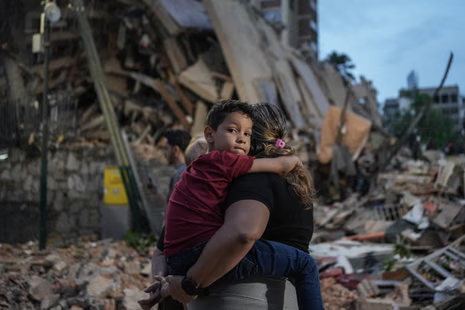
Luke 13:1–5 and the Venezuela Earthquake: A Call to Repentance for Everyone
News of earthquakes, floods, wars, and other natural disasters often raises difficult questions. Following the recent earthquake in Venezuela, many believers have asked whether such tragedies are God’s judgment upon a particular nation or its people.
Jesus Himself answered this question nearly two thousand years ago.
In Luke 13:1–5, some people informed Jesus about Galileans whose blood Pilate had mixed with their sacrifices. It was a shocking act of violence, and those listening expected Jesus to explain why those people had suffered such a terrible fate.
Instead, Jesus challenged their assumptions.
“Do you think that these Galileans were worse sinners than all the other Galileans because they suffered these things? I tell you, No; but unless you repent, you will all likewise perish.” (Luke 13:2–3)
Then Jesus referred to another tragedy:
“Or those eighteen on whom the tower in Siloam fell and killed them, do you think that they were worse offenders than all the others living in Jerusalem? I tell you, No; but unless you repent, you will all likewise perish.” (Luke 13:4–5)
Jesus Rejects the False Idea That Disaster Victims Are Greater Sinners
Human nature often searches for explanations after tragedy.
People ask:
- Why did this happen?
- Was God judging them?
- Did they deserve it?
Jesus answered these questions directly.
The Galileans murdered by Pilate were not greater sinners.
The eighteen people crushed by the tower of Siloam were not worse than everyone else.
Likewise, when we hear about earthquakes in Venezuela or any other country, Scripture does not authorize us to conclude that the victims were more sinful than people elsewhere.
This passage calls us away from judging others and toward examining our own hearts.
Every Tragedy Is a Reminder of Life’s Fragility
Although Jesus rejected the idea that disasters prove greater guilt, He also used these events to teach an urgent spiritual lesson.
Twice He repeated:
“Unless you repent, you will all likewise perish.”
The emphasis is not on the victims.
The emphasis is on everyone who is still alive.
Each disaster reminds us that life is uncertain.
No one knows the day or hour when their earthly life will end.
An earthquake, accident, illness, or sudden tragedy reminds us that tomorrow is never guaranteed.
“Already the Axe Is Laid to the Root of the Trees”
John the Baptist delivered another solemn warning:
“Even now the axe is laid to the root of the trees. Therefore every tree which does not bear good fruit is cut down and thrown into the fire.” (Matthew 3:10)
This vivid image teaches urgency.
The tree still stands.
The axe has not yet struck.
But it is already positioned.
Likewise, God is patient and merciful, giving people time to repent. Yet His patience should never be mistaken for indifference.
Every day is another opportunity to turn to Christ.
No one knows how much time remains.
Death Can Come at Any Moment
Modern society often avoids thinking about death.
We make plans for years ahead.
We assume there will always be another tomorrow.
But Scripture repeatedly reminds us that life is brief.
James wrote:
“What is your life? It is even a vapor that appears for a little time and then vanishes away.” (James 4:14)
Whether through natural causes, accidents, disasters, or old age, every person will one day stand before God.
The question is not whether death will come.
The question is whether we are ready to meet our Creator.
The Lord Is Patient Because He Desires Repentance
God’s warnings are expressions of His mercy.
The apostle Peter explains:
“The Lord is not slow concerning His promise… but is patient toward you, not wishing that any should perish, but that all should come to repentance.” (2 Peter 3:9)
God does not delight in destruction.
He delights when sinners turn to Him.
Every day of life is another invitation to receive His grace through Jesus Christ.
What Should Christians Do When They Hear of Disasters?
Instead of asking whether the victims deserved their suffering, believers should respond in biblical ways.
Pray
Pray for those who have lost loved ones, homes, and security.
Show Compassion
Jesus was moved with compassion toward those who suffered.
Christians should likewise demonstrate practical love and mercy.
Examine Your Own Heart
Every tragedy should cause us to ask:
Am I walking with Christ?
Is there unconfessed sin in my life?
Am I spiritually prepared if today were my last day?
Share the Gospel
Disasters remind people that earthly life is temporary.
These moments often open hearts to hear the good news of Jesus Christ.
Repent Today
Jesus did not say,
“Repent someday.”
He said,
“Unless you repent…”
Repentance means turning away from sin and turning toward God through faith in Jesus Christ.
It is not merely feeling sorry.
It is a change of heart that produces a changed life.
The greatest tragedy is not dying in an earthquake.
The greatest tragedy is dying without Christ.
Conclusion
The recent earthquake in Venezuela reminds us of the very lesson Jesus taught in Luke 13:1–5.
We should never assume that those who suffer disasters are greater sinners than others.
Instead, every tragedy should remind each one of us that life is fragile, eternity is real, and today is the day to seek the Lord.
John the Baptist declared that the axe is already laid at the root of the trees.
God’s patience is still extended.
His invitation still stands.
But none of us knows how many days remain.
Therefore, let us heed the words of Jesus:
“Unless you repent, you will all likewise perish.” (Luke 13:5)
May every earthquake, every tragedy, and every reminder of life’s uncertainty move us—not to judge others—but to humble ourselves before God, repent of our sins, and place our complete trust in Jesus Christ while there is still time.
Now thanks be unto God, which always causeth us to triumph in Christ (2 Corinthians 2:14).
God gets His greatest victories out of apparent defeats. Very often the enemy seems to triumph for a little, and God lets it be so; but then He comes in and upsets all the work of the enemy, overthrows the apparent victory, and as the Bible says, "turns the way of the wicked upside down." Thus He gives a great deal larger victory than we would have known if He had not allowed the enemy, seemingly, to triumph in the first place.
The story of the three Hebrew children being cast into the fiery furnace is a familiar one. Here was an apparent victory for the enemy. It looked as if the servants of the living God were going to have a terrible defeat. We have all been in places where it seemed as though we were defeated, and the enemy rejoiced. We can imagine what a complete defeat this looked to be. They fell down into the flames, and their enemies watched them to see them burn up in that awful fire, but were greatly astonished to see them walking around in the fire enjoying themselves. Nebuchadnezzar told them to "come forth out of the midst of the fire." Not even a hair was singed, nor was the smell of fire on their garments, "because there is no other god that can deliver after this sort."
This apparent defeat resulted in a marvelous victory.
Suppose that these three men had lost their faith and courage, and had complained, saying, "Why did not God keep us out of the furnace!" They would have been burned, and God would not have been glorified. If there is a great trial in your life today, do not own it as a defeat, but continue, by faith, to claim the victory through Him who is able to make you more than conqueror, and a glorious victory will soon be apparent. Let us learn that in all the hard places God brings us into, He is making opportunities for us to exercise such faith in Him as will bring about blessed results and greatly glorify His name.
Discover more from My Blog-BesthomeBusiness
Subscribe to get the latest posts sent to your email.