
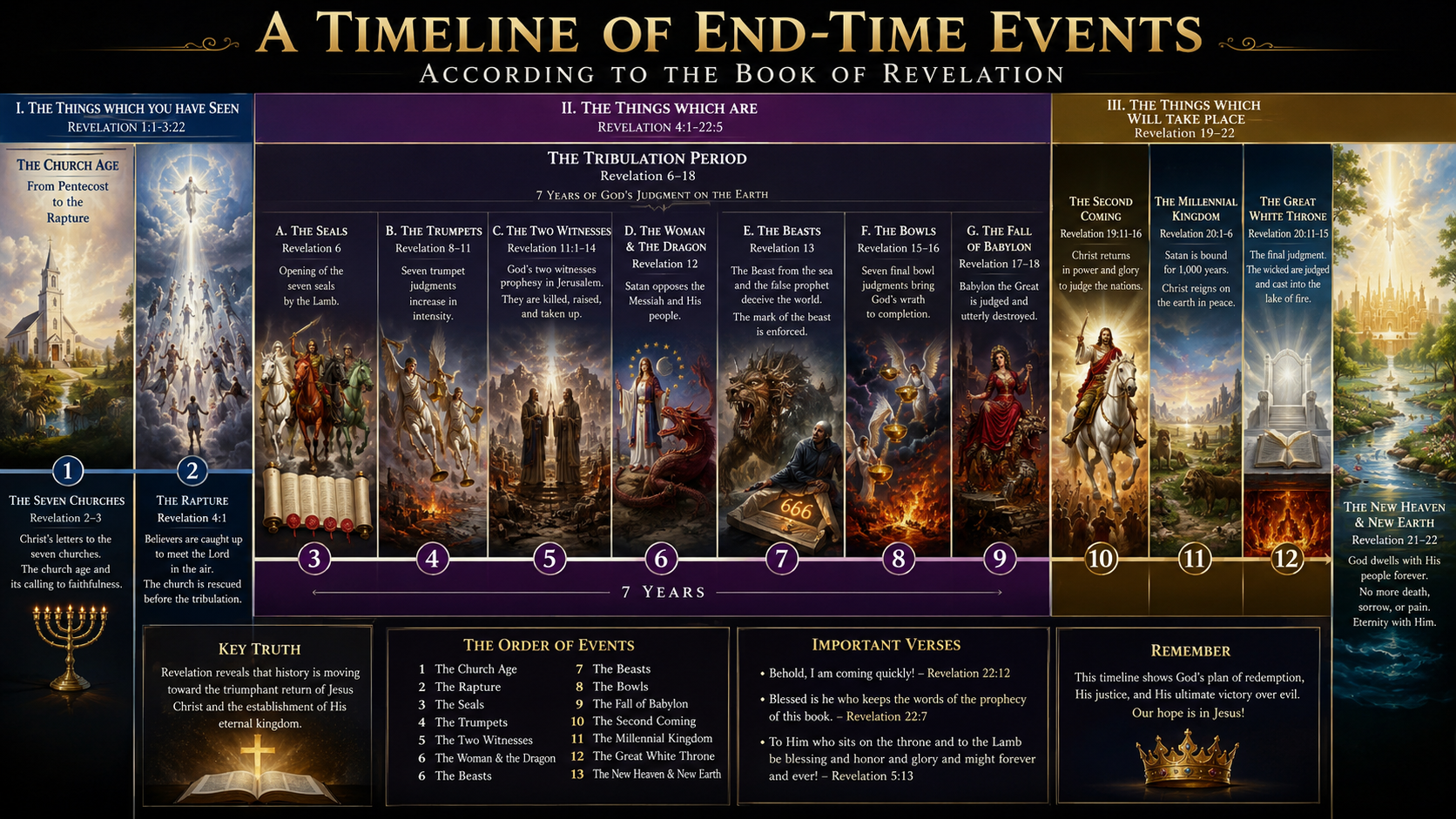
A Detailed Timeline of End-Time Events According to the Book of Revelation
The Book of Revelation is one of the most fascinating and debated books in the Bible. Written by the Apostle John while exiled on the island of Patmos, Revelation contains visions, symbols, warnings, and promises concerning the future. While Christians differ on some details of interpretation, Revelation provides a broad picture of God’s ultimate victory over evil and the establishment of His eternal kingdom.
This article presents a chronological overview of the major end-time events described in Revelation from a premillennial perspective, one of the most widely held views among evangelical Christians.
1. The Church Age
The timeline begins with the current era often called the Church Age. Revelation chapters 2 and 3 contain letters from Jesus Christ to seven churches in Asia Minor. While these churches were real congregations, many Bible teachers see them as representing conditions that characterize the Church throughout history.
During this period:
- The Gospel is preached worldwide.
- Believers are called to remain faithful.
- The Church faces persecution, compromise, and spiritual challenges.
- Christians await the return of Christ.
Jesus repeatedly encourages believers to overcome and remain watchful.
2. The Rapture of the Church
Many Christians believe the next major event is the Rapture, when Jesus gathers His followers to Himself.
Key Scriptures:
- 1 Thessalonians 4:16-17
- 1 Corinthians 15:51-52
Although Revelation does not explicitly describe the Rapture in detail, many interpreters connect it with Revelation 4:1, where John is called up into heaven.
During the Rapture:
- Dead believers are resurrected.
- Living believers are transformed.
- Christians meet Christ in the air.
- The Church is removed from God’s coming judgment.
This event is expected to occur suddenly and unexpectedly.
3. The Rise of the Antichrist
Following the removal of the Church, a powerful world leader emerges.
Revelation 13 introduces the Beast, commonly known as the Antichrist.
Characteristics include:
- Extraordinary political influence.
- Charismatic leadership.
- Global authority.
- Opposition to God.
- Deception of nations.
The Antichrist initially appears as a peacemaker but eventually reveals his true nature as a ruthless dictator.
4. The Seven-Year Tribulation Begins
The Tribulation is a period of unprecedented suffering and judgment upon the earth.
This seven-year period is often associated with Daniel’s seventieth week (Daniel 9:27).
The Tribulation includes:
- Global instability.
- Economic turmoil.
- Natural disasters.
- Religious deception.
- Persecution of believers.
The judgments unfold in three series: seals, trumpets, and bowls.
5. The Seven Seal Judgments
In Revelation chapters 6 through 8, Jesus opens seven seals on a heavenly scroll.
First Seal: White Horse
A rider emerges symbolizing conquest and deception.
Second Seal: Red Horse
War spreads throughout the world.
Third Seal: Black Horse
Famine and economic hardship occur.
Fourth Seal: Pale Horse
Death and widespread destruction affect humanity.
Fifth Seal
Martyrs cry out for justice.
Sixth Seal
Massive cosmic disturbances shake the earth.
Seventh Seal
Introduces the trumpet judgments.
These judgments demonstrate God’s sovereignty and warn humanity to repent.
6. The Seven Trumpet Judgments
Revelation chapters 8 through 11 describe seven trumpets.
First Trumpet
Vegetation is severely damaged.
Second Trumpet
A great object strikes the sea.
Third Trumpet
Fresh water sources become contaminated.
Fourth Trumpet
The sun, moon, and stars are darkened.
Fifth Trumpet
Demonic forces torment unbelievers.
Sixth Trumpet
A massive army causes widespread destruction.
Seventh Trumpet
The kingdom of Christ is announced.
The trumpet judgments intensify the severity of God’s judgments.
7. The Mark of the Beast
One of Revelation’s most well-known prophecies appears in chapter 13.
The False Prophet supports the Antichrist and promotes worship of him.
People are required to receive a mark associated with the Beast to participate in commerce.
The mark symbolizes loyalty to the Antichrist’s system.
Believers are warned not to accept it regardless of the consequences.
8. The Great Tribulation
The second half of the seven-year Tribulation is often called the Great Tribulation.
Jesus described it as a time unlike any in human history.
Features include:
- Intense persecution.
- Worldwide deception.
- Escalating judgments.
- Increasing rebellion against God.
Despite overwhelming evidence of God’s power, many people refuse to repent.
9. The Seven Bowl Judgments
Revelation chapters 15 and 16 describe the final series of judgments.
First Bowl
Painful sores afflict followers of the Beast.
Second Bowl
The sea is turned to blood.
Third Bowl
Fresh waters are affected.
Fourth Bowl
Extreme heat scorches humanity.
Fifth Bowl
Darkness covers the Beast’s kingdom.
Sixth Bowl
The Euphrates River dries up.
Seventh Bowl
A catastrophic earthquake shakes the earth.
These judgments prepare the way for the final confrontation between God and evil.
10. The Fall of Babylon
Revelation chapters 17 and 18 describe the destruction of Babylon.
Babylon represents a corrupt world system characterized by:
- Spiritual rebellion.
- Materialism.
- Immorality.
- Opposition to God.
Its collapse signals the end of humanity’s organized rebellion against God’s authority.
11. The Battle of Armageddon
The nations gather for a final conflict known as Armageddon.
Led by the Antichrist, world powers unite against God.
This battle takes place near Megiddo in Israel.
The conflict appears overwhelming, but God’s victory is certain.
12. The Second Coming of Jesus Christ
One of Revelation’s most glorious moments occurs in chapter 19.
Jesus returns visibly and triumphantly.
At His return:
- He defeats the Antichrist.
- The False Prophet is judged.
- Evil armies are destroyed.
- God’s kingdom is established.
Unlike His first coming in humility, Christ returns in power and glory.
13. Satan Bound for One Thousand Years
Following Christ’s return, Satan is bound and confined.
This prevents him from deceiving the nations during Christ’s reign.
The Millennium begins.
14. The Millennial Kingdom
Revelation 20 describes a thousand-year reign of Christ on earth.
Characteristics include:
- Peace.
- Justice.
- Righteous government.
- Worship centered on God.
- Fulfillment of many Old Testament prophecies.
Christ reigns as King over all nations.
15. Satan’s Final Rebellion
At the end of the Millennium, Satan is released briefly.
He deceives many people and gathers them for one final rebellion.
God quickly defeats this uprising.
Satan is then cast into the lake of fire forever.
16. The Great White Throne Judgment
Revelation 20 describes the final judgment.
All unbelievers stand before God.
Books are opened.
Every person is judged according to their deeds.
Those whose names are not found in the Book of Life face eternal separation from God.
This judgment demonstrates God’s perfect justice.
17. The New Heaven and New Earth
Revelation chapters 21 and 22 conclude with the creation of a new heaven and new earth.
The old order passes away.
God establishes His eternal kingdom.
Features include:
- No death.
- No sorrow.
- No pain.
- No tears.
- Perfect fellowship with God.
The New Jerusalem descends from heaven, and God’s people dwell with Him forever.
Conclusion
The Book of Revelation reveals much more than future events. Its central message is that Jesus Christ is victorious. Despite wars, suffering, deception, and judgment, God’s purposes will ultimately prevail. Revelation encourages believers to remain faithful, live holy lives, and place their hope in the returning King.
The final chapters of Scripture end not with fear, but with hope. God’s promise is clear: He will make all things new, defeat evil forever, and dwell with His people for eternity.
As Revelation concludes, Christians throughout the centuries have echoed its final prayer:
“Even so, come, Lord Jesus.”
Now thanks be unto God, which always causeth us to triumph in Christ (2 Corinthians 2:14).
God gets His greatest victories out of apparent defeats. Very often the enemy seems to triumph for a little, and God lets it be so; but then He comes in and upsets all the work of the enemy, overthrows the apparent victory, and as the Bible says, "turns the way of the wicked upside down." Thus He gives a great deal larger victory than we would have known if He had not allowed the enemy, seemingly, to triumph in the first place.
The story of the three Hebrew children being cast into the fiery furnace is a familiar one. Here was an apparent victory for the enemy. It looked as if the servants of the living God were going to have a terrible defeat. We have all been in places where it seemed as though we were defeated, and the enemy rejoiced. We can imagine what a complete defeat this looked to be. They fell down into the flames, and their enemies watched them to see them burn up in that awful fire, but were greatly astonished to see them walking around in the fire enjoying themselves. Nebuchadnezzar told them to "come forth out of the midst of the fire." Not even a hair was singed, nor was the smell of fire on their garments, "because there is no other god that can deliver after this sort."
This apparent defeat resulted in a marvelous victory.
Suppose that these three men had lost their faith and courage, and had complained, saying, "Why did not God keep us out of the furnace!" They would have been burned, and God would not have been glorified. If there is a great trial in your life today, do not own it as a defeat, but continue, by faith, to claim the victory through Him who is able to make you more than conqueror, and a glorious victory will soon be apparent. Let us learn that in all the hard places God brings us into, He is making opportunities for us to exercise such faith in Him as will bring about blessed results and greatly glorify His name.
Discover more from My Blog-BesthomeBusiness
Subscribe to get the latest posts sent to your email.