
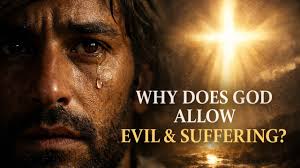
Why Does God Allow Suffering and Evil? A Biblical Answer to Faith’s Hardest Question
The Question That Shakes Faith
“If God is all-powerful and all-loving, why does He allow suffering and evil in the world?”
You’re not alone in asking this. Believers and skeptics have wrestled with it for millennia. Philosophers call it the “problem of evil,” and it remains one of the most honest, searching questions a person of faith can ask.
The logical argument typically goes like this: If God is omnipotent (all-powerful), omniscient (all-knowing), and omnibenevolent (all-loving), then evil shouldn’t exist. Since evil clearly does exist, perhaps God lacks one of these attributes — or doesn’t exist at all.
But this framing rests on a critical assumption: that an all-loving God would have no morally sufficient reason for permitting evil. Scripture challenges that assumption at every turn.
What the Bible Says About Suffering
1. Free Will Requires the Possibility of Evil
God created humans with genuine free will — and He did so because love requires choice. A relationship forced is not love at all. As C.S. Lewis observed, free will makes evil possible, but it is also the only thing that makes genuine love, goodness, and joy possible.
Deuteronomy 30:19 captures this tension beautifully: “I have set before you life and death, blessing and cursing: therefore choose life.” God presents the choice. He doesn’t override it.
2. Suffering Entered Through the Fall, Not God’s Design
Scripture is clear that suffering was not God’s original intention for creation. It entered the world through human rebellion.
Romans 5:12 tells us: “Just as sin entered the world through one man, and death through sin, and in this way death came to all people, because all sinned.” Genesis 3:17–19 goes further — creation itself became subject to decay as a consequence of the Fall. The world we see, marked by pain and death, is not the world God designed. It is a world fractured by sin.
3. God Redeems Suffering — He Doesn’t Just Allow It
Perhaps the most profound biblical truth about suffering is that God doesn’t merely permit it from a distance. He enters into it and redeems it.
Romans 8:28 promises: “And we know that in all things God works for the good of those who love him, who have been called according to his purpose.”
The Cross itself is the greatest demonstration of this truth. What looked like the ultimate defeat — the death of an innocent man — became the source of eternal salvation. God’s greatest victory came through the greatest suffering.
4. We Live in the “Already / Not Yet”
We exist in a particular moment in God’s redemptive story — between Christ’s first coming, where He defeated sin and death, and His return, when all suffering will finally cease.
Revelation 21:4 gives us the promised ending: “He will wipe every tear from their eyes. There will be no more death or mourning or crying or pain.” We are not there yet, but we are heading there.
What About Innocent Children Who Suffer?
This is the sharpest edge of the problem — and it deserves a direct, honest response.
God Is Not Indifferent
Jesus reserved His strongest words for those who harm children. In Matthew 18:5–6, He says that anyone who causes “one of these little ones” to stumble would be better off drowned in the depths of the sea. God’s heart for children is fierce and protective, not passive.
We Live in an Interconnected World
One of the painful realities of human existence is that sin has ripple effects. A drunk driver kills a child. A corrupt government starves its people. Generational trauma passes from parent to child. This is not God punishing the innocent — it is the tragic consequence of living in a world where human choices have real effects on others. God gave humanity real freedom and real dominion (Genesis 1:28), and we have used that freedom to wound one another.
Creation Itself Is Groaning
What about disease, natural disasters, or birth defects — evils that can’t be traced to any individual’s choice? Romans 8:20–22 points to creation itself being “subjected to frustration,” waiting to be “liberated from its bondage to decay.” The natural world is broken alongside humanity. Children’s fragile bodies are caught in that brokenness.
Jesus Wept First, Then He Acted
When Jesus encountered suffering, He did not offer philosophical explanations. He wept (John 11:35). He healed. He raised the dead. His first response was presence and compassion — not detached theology. That is the model He set for us.
What the Bible Does NOT Promise
The Bible never promises that we will understand why specific suffering happens. Isaiah 55:8–9 is a humbling reminder: “For my thoughts are not your thoughts, neither are your ways my ways.” There will be things we cannot see or comprehend in this life.
What the Bible DOES Promise
- God is present with us in our suffering — “Even though I walk through the darkest valley, I will fear no evil, for you are with me” (Psalm 23:4)
- Suffering produces character and hope (Romans 5:3–5)
- Our present suffering is temporary; the glory ahead is eternal (2 Corinthians 4:17)
- Absolutely nothing can separate us from God’s love (Romans 8:38–39)
- Every suffering child is seen and held by Him (Psalm 139:16; Matthew 19:14)
- Justice will come — every wrong will be made right (Revelation 20:12–13)
The Most Important Truth of All
The Cross tells us something that changes everything: God did not exempt Himself from suffering. He entered it. He experienced the death of an innocent — His own Son.
Whatever we cannot understand about suffering, we can know this: God is not a distant deity who permits pain He is unwilling to share. He is not the author of evil. He is its ultimate victim — and its final conqueror.
The suffering of children remains a horror. But God is not unmoved and He is not finished. And for those who die in innocence, Scripture assures us they are received into His arms (2 Samuel 12:23; Matthew 19:14).
Sometimes these questions aren’t just philosophical — they’re deeply personal. If you’re walking through suffering right now, know that you are not alone, and God is not far. Reach out to your church community, a pastor, or a trusted friend who can walk with you.
Stay Connected & Grow in Faith
Thank you for taking time to read this message. God’s Word continues to speak beyond the written page—through worship, teaching, and faithful voices that proclaim His truth.
We invite you to stay connected with our ministry through our Christian Radio: Radio Christian Truth and Christian TV: Faros TV,where you’ll find Christ-centered worship, biblical teaching, and encouraging programs designed to strengthen your faith and deepen your walk with Jesus.
🎧 Listen to Christian Radio
📺 Watch Christian TV
May the Lord bless you as you seek Him daily, and may His Word guide, encourage, and transform your life.
Discover more from My Blog-BesthomeBusiness
Subscribe to get the latest posts sent to your email.